
Carlos Slim
Carlos Slim is the Mexican businessman who built Grupo Carso, a conglomerate whose fortune rests mainly on telecommunications.
Price as information, when the mechanism is working.


eBay acquired PayPal on October 3, 2002, for $1.4–$1.5 billion. It shut down its competing Billpoint service three months later. PayPal became the dominant, user-chosen payment method on eBay — used in over 70% of auctions and ~25% of closed listings — and by Q3 2012 accounted for 40% of eBay’s revenue ($1.37B). The deal was not about innovation. It was about controlling the checkout.























CME Group is a vertically integrated derivatives infrastructure operator. It runs exchanges, provides mandatory central clearing, and operates two spot platforms. In 2025, 81% of its revenue came from clearing and transaction fees, charged at $0.70 per contract across over 7 billion contracts. Volume increases during market volatility — a mechanical, observable feature. Its Bitcoin spot launch in May 2024 has no reported volume or revenue impact. Every major innovation — currency futures (1972), Globex (1987), IPO (2002) — was structural, not product-led.



Moody's Ratings is the credit ratings division of Moody's Corporation, rebranded from Moody's Investors Service in March 2024. It provides international financial research on bonds issued by commercial and government entities, operates as one of the Big Three credit rating agencies, uses a standardized ratings scale measuring expected investor loss in default, assigns ratings from Aaa (highest) to C (lowest), and was founded by John Moody in 1909 to produce manuals of statistics related to stocks, bonds, and bond ratings.

Nasdaq is not a disruptor — it is the incumbent infrastructure operator. Its value lies in ownership of exchange platforms, data feeds, and listing rules — not in technological novelty, which has long since been replicated. It works where liquidity and branding converge: tech IPOs, real-time data sales, and cross-border access. It falls short as a neutral arbiter: its incentives align with listed companies and high-frequency traders, not retail investors or public market integrity. The gap between its self-presentation as a ‘market enabler’ and its actual function as a toll collector is wide — and profitable.






Soros Fund Management is a case study in regulatory adaptation: a firm that built its reputation on transparency of idea (macro thesis) and opacity of structure (family office), where the numbers remain impressive but uncheckable.

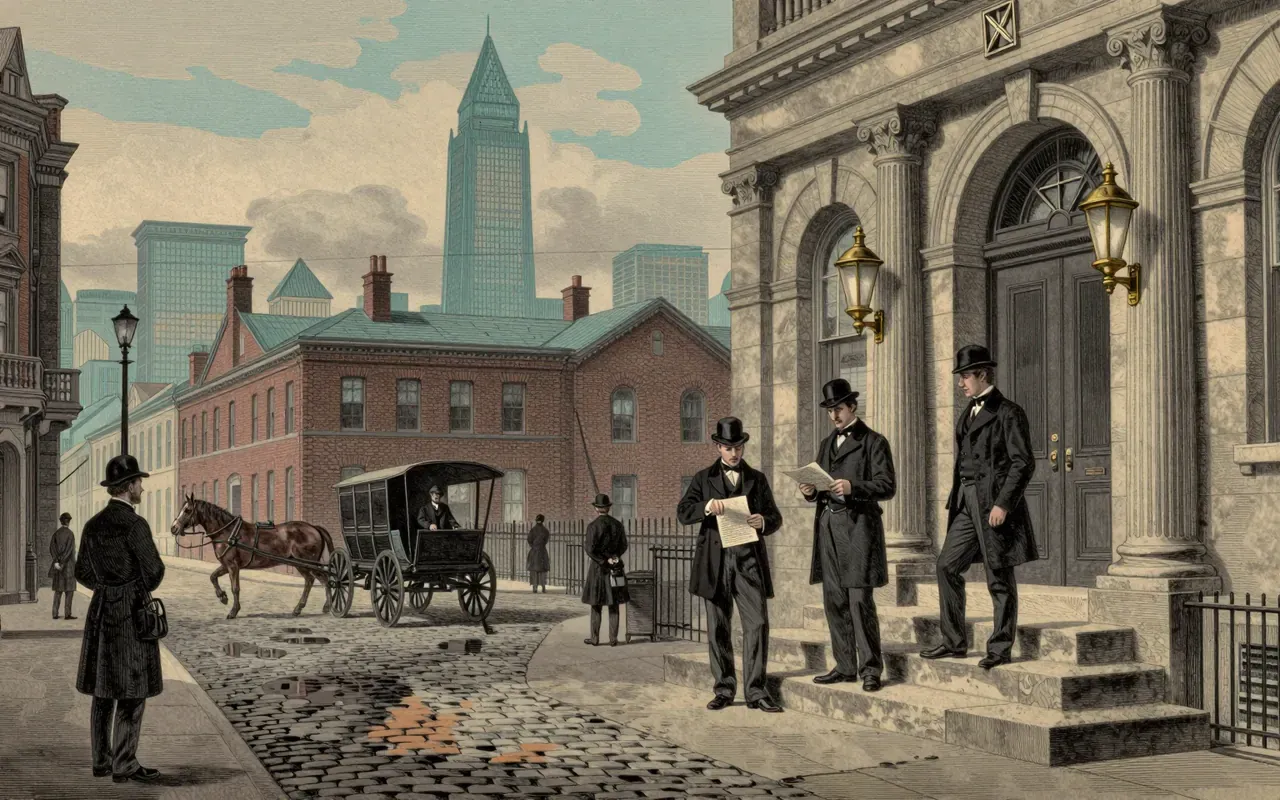



Marks & Spencer began as a £5 stall with a slogan — not a brand, not a department store, but a refusal to haggle.


Goldman Sachs is a multinational investment bank and financial services company founded in 1869 and headquartered in New York City. It offers investment banking (advisory for mergers and acquisitions and restructuring), securities underwriting, prime brokerage, asset management, and wealth management. It acts as a market maker, operates private-equity and hedge funds, structures complex and tailor-made financial products, owns Goldman Sachs Bank USA (a direct bank), and trades both on behalf of clients and for its own account.

Morgan Stanley is a financial institution whose origin story is legally precise, but whose current identity is structurally ambiguous. It began as a Glass–Steagall-mandated spin-off — not a startup, not a rebellion, but a regulatory necessity. Its early market share proves execution mattered more than ideology. Its 1997 merger erased the line between investment banking and mass-market finance — yet the firm still trades on the prestige of 1935. That dissonance is the real story.