What the company or idea is
Sony is a Japanese electronics company founded in 1946 as Tokyo Tsushin Kogyo K.K. by Masaru Ibuka and Akio Morita.
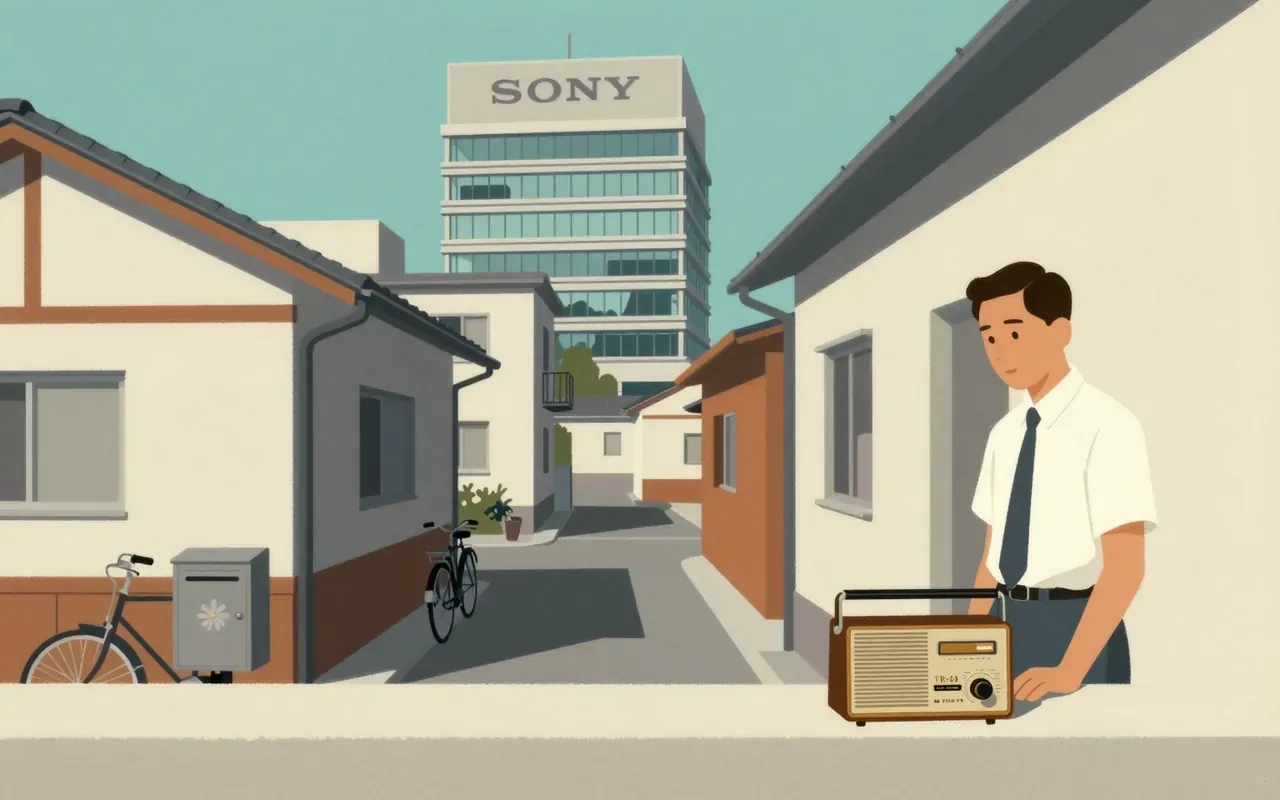
It started in 1946 as an electronics shop in a Tokyo department store, with capital of ¥190,000 and eight employees. The first Sony-branded product, the TR-55 transistor radio, appeared in 1955, three years before the company took the name. Mitsui, its principal bank, pushed for a name such as Sony Electronic Industries; Morita held out because he did not want the name tied to any particular industry.
How it actually makes money
The document does not state how Sony made money.
For the 2025 fiscal year Sony Group generated roughly ¥12.48 trillion in revenue (about $83.4 billion), and Game & Network Services was the largest share at around ¥4.69 trillion (about $31 billion). The other segments are Entertainment, Technology & Services, Imaging & Sensing Solutions, Pictures and Music; Financial Services was partly spun off in late 2025.
What works
Sony cracked open the U.S. market with the TR-63 radio and launched the consumer microelectronics industry; it pioneered Japan’s first tape recorder (Type-G), the world’s first all-transistor TV (TV8-301), and the Trinitron CRT line.
It did not stay a hardware-only company. In 1988 it bought CBS Record Group for $2 billion and in 1989 Columbia Pictures Entertainment for $3.4 billion. The PlayStation grew out of a failed partnership with Nintendo, which broke it off after the two could not agree how revenue would be split. The first PlayStation captured 61% of global console sales over its life, and the PlayStation 2 passed 160 million units.
What does not
The document says nothing about Sony’s cost structure, margins, pricing, distribution channels, licensing, or revenue sources.
The model failed in several places. Sony’s Betamax lost the videotape format war to JVC’s VHS. In the early 1980s recession electronics sales dropped and it was forced to cut prices; one analyst concluded that its best days were behind it. Its push for “convergence” of film, music and digital electronics is described as unrewarding and unprofitable. By 2014 its television business had lost a total of $7.8 billion over a decade, and its global television share fell from up to 20% at the height of Trinitron to under 10% by 2012 and below 2% by 2025. The PlayStation 3 launched at a price that cost Sony an estimated $240 to $300 on every console sold.
What to take from it
Sony’s early success came from building first-of-kind hardware (tape recorders, transistor radios, all-transistor TVs) and renaming itself for global recognition — not from software, services, or scale.
Later chapters complicate that reading. Howard Stringer, the first foreigner to run a major Japanese electronics firm, took over as chief executive in 2005, cut 9,000 jobs and described the company’s business units as “silos” operating in isolation from one another. Kazuo Hirai followed in 2012 with a “One Sony” initiative, and in 2014 Sony sold its Vaio PC division. In March 2026 it agreed a joint venture with TCL for its home entertainment business, in which TCL holds 51% and Sony 49% and keeps product design, image processing technology and brand standards.
Is it worth your time
Yes — as a case study in deliberate naming, export-led product strategy, and the mechanics of cross-border market entry via physical hardware.