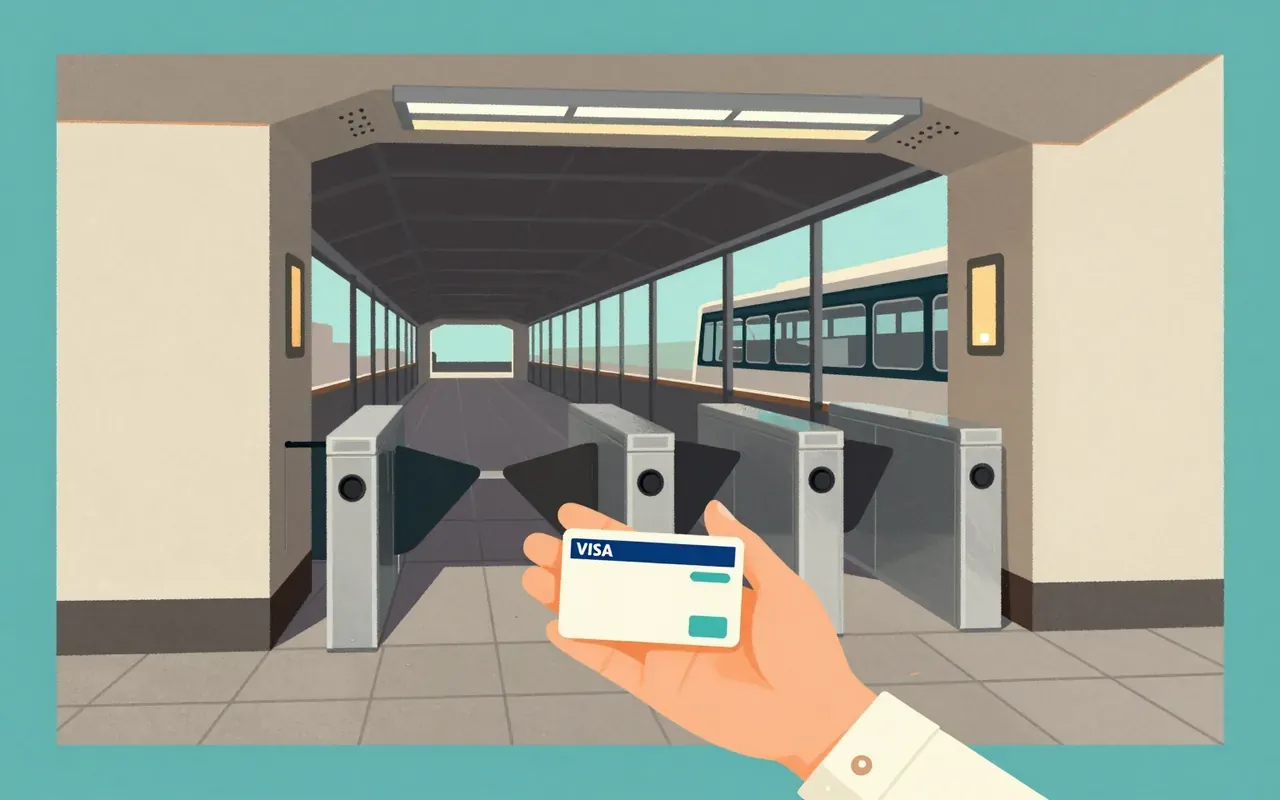
Visa isn’t a bank or a tech platform — it’s a governance fiction that works because nobody questions who really decides.
Visa is a payment infrastructure built on delegation: banks issue cards, Visa provides the rails and branding, and consumers pay fees embedded in every transaction. Its 1970 restructuring into a member-owned, decentralised association — conceived and led by Dee Hock — was a deliberate rejection of hierarchy. Yet its 2025 volume ($14.2 trillion) reflects not distributed decision-making but tightly coordinated standards enforcement. The ‘chaordic’ ideal remains descriptive, not operational.
Visa began not as an independent company but as Bank of America’s licensed credit card program — then became a member-owned entity only after the bank relinquished control.
3:08
A Name Change Was a Power Shift
National BankAmericard was formed in 1970 when issuer banks took control — and renamed themselves Visa in 1976.
4:45
No Lending, No Control, No CEO
Visa makes money from transaction fees and licensing — not lending — and was deliberately structured to avoid central authority.
6:26
Scale ≠ Shared Power
VisaNet processed $14.2 trillion in transactions in 2025 — proof that chaordic design can scale, but not evidence of democratic governance.
Worth your time?
Yes. Study the whole thing.
4.5/ 5
What works
decentralised governance at scale
standardisation without state mandate
fee-based infrastructure monetisation
What does not
disrupt
innovate technologically
own customer relationships
Study it if
infrastructure designers
cooperative organisers
payment regulation analysts
Skip it if
startup founders seeking validation
investors assessing growth potential
consumers looking for transparency
The written brief1 min read
What the company or idea is
Visa is a multinational payment card services corporation founded in 1958 as BankAmericard, restructured in 1970 into a member-owned, decentralised association led by Dee Hock, and renamed Visa in 1976.
How it actually makes money
Visa makes money by licensing its brand and network to financial institutions, which issue cards and set consumer terms; Visa collects fees per transaction processed on its network.
What works
Its decentralised, member-owned structure allowed banks to retain control while sharing infrastructure costs — enabling rapid cross-border scaling without centralised capital or regulatory capture.
What does not
Visa does not issue cards, extend credit, or set consumer rates and fees. It has no direct relationship with cardholders and bears no credit risk.
What to take from it
The gap between Visa’s self-presentation as a neutral network and its actual role as a de facto central coordinator of global payments reveals how infrastructure gains power by obscuring governance behind standardisation.
Is it worth your time
Yes — it is a rare, documented case of a globally scaled, member-owned, decentralised infrastructure built without equity ownership or state backing.