businessbriefs
11:34in productionCh. 1 · How it began/ 11:34 · ceiling 15 min
Companies

Surgutneftegas

Surgutneftegas is not a private company in the market sense — it is a state asset rebranded under permanent management.

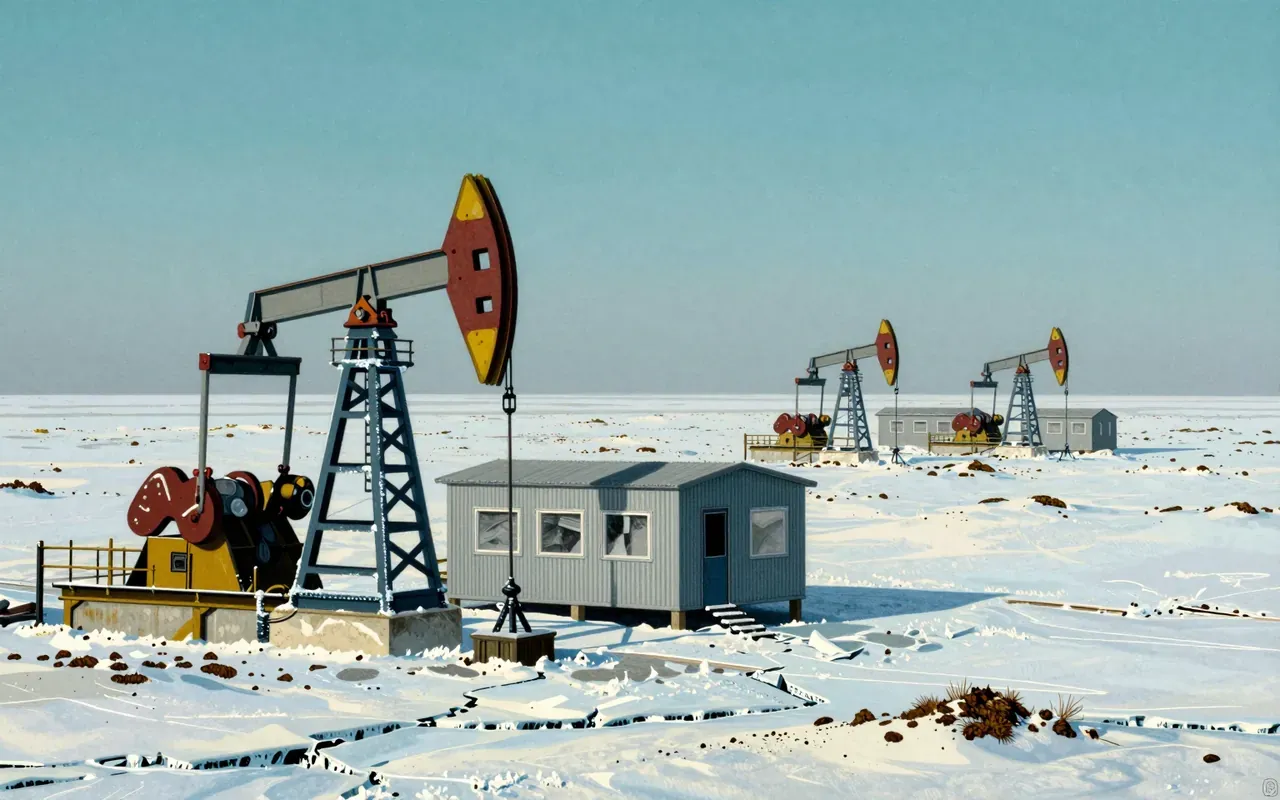
Surgutneftegas is a Russian oil and gas company formed in 1994 by merging state-owned entities holding major Western Siberian reserves. It became a private company in 1993 and has operated under Vladimir Bogdanov’s leadership since. Its business model relies on control of upstream assets, state-granted infrastructure rights, and export relationships — not capital markets, innovation, or transparency.

Chapters & takeaways4
  1. 1:07
    How it began

    It was never built from scratch — it was assembled from Soviet state holdings and reclassified as private in 1993.

  2. 2:33
    How it expanded

    Its growth came from winning tenders and securing infrastructure rights — not innovation or capital markets.

  3. 4:23
    How it projects power

    Its influence extended beyond operations — into contested acquisitions and foreign supply dominance.

  4. 6:03
    How it scales

    Revenue grew from $24 billion in 2007 to 1.5 trillion rubles in 2018 — but no source explains cost structure or margins.

Worth your time?

Yes. Study the whole thing.

3.5/ 5
What works
  • consolidating Soviet-era resource control
  • securing infrastructure rights
  • leveraging export relationships
What does not
  • operates transparently
  • discloses ownership structure
  • relies on capital markets for growth
Study it if
  • students of post-Soviet economic transition
  • analysts of state-capital hybrids
  • readers tracking energy geopolitics
Skip it if
  • investors seeking financial clarity
  • entrepreneurs looking for scalable models
  • policy designers aiming for market reform examples
The written brief1 min read

What the company or idea is

Surgutneftegas is a Russian oil and gas company formed in 1994 by merging state-owned entities holding major Western Siberian reserves; it became a private company in 1993 and has been led by Vladimir Bogdanov since then.

How it actually makes money

Surgutneftegas makes money by extracting oil from Western Siberian reserves it acquired through state asset mergers and tenders, refining it at Kirishi, and exporting it — notably supplying 30% of Belarus’s oil in 2006.

What works

Its control over vast Western Siberian fields, permission to build export infrastructure (Batareynaya Bay terminal and pipeline to Kirishi), and dominance in Belarusian supply give it stable revenue and geopolitical leverage.

What does not

It does not operate transparently: its role in the 2004 Yuganskneftegaz acquisition remains officially unconfirmed, and its ownership structure is opaque despite its scale.

What to take from it

Its trajectory shows that privatisation in Russia did not mean market discipline — it meant consolidation of state assets under long-standing managers with political access and infrastructure control.

Is it worth your time

Yes — as a case study in how Soviet-era resource control was converted into private, vertically integrated energy power without market liberalisation or transparency.
Same desk · Companies4 of 315
10:34
Airbus1998Airbus in 1998 was a consortium — not a company — sustained by national governments and bound by treaty, not equity. Its money came from airliner sales, but its structure reflected diplomacy more than business logic. It worked because Europe prioritised strategic autonomy over market efficiency. It failed as a unified enterprise until it abandoned the consortium model entirely. The lesson is structural: scale in aerospace is political first, economic second.
12:10
Anglo American plc1917Anglo American plc is a British multinational mining company headquartered in London, founded in 1917 in Johannesburg. It is the world's largest platinum producer (40% of global output) and owns 85% of De Beers. It merged with Minorco in 1999 to become Anglo American plc, and with Teck Resources in 2025 to form Anglo Teck. Between 2015 and 2015, it cut 138,000 jobs. In early 2015, it reported a $3 billion loss. It withdrew from the Pebble Mine in 2013 and partnered with Engie and First Mode in 2019 to develop a hydrogen-powered haul truck.
10:53
ArcelorMittalLakshmi Mittal · 2006ArcelorMittal is the world’s second-largest steelmaker — a $33 billion hostile merger of Mittal Steel and Arcelor in 2007. It operates across mining, smelting, and recycling in 14 countries. In 2025, it produced 55.6 million tons of steel against 74.6 million tons of capacity — 53% in Europe, 40% in the Americas. It sources 72% of its iron ore and 91% of its coke internally. The Mittal family surrendered control to close the deal. It is not a technology company. It is not growing. It is a vertically integrated commodity producer whose scale is structural, not strategic.
11:50
Barrick MiningPeter Munk · 1983Barrick Mining is a gold-and-copper extraction company built through strategic acquisitions — not innovation, not discovery, not vertical integration. Its value lies in scale: 89 million ounces of gold in reserves, 3.91 million ounces produced in 2024, and a history of absorbing rivals like Placer Dome. But its governance fails where operations meet people: in 2008, Peter Munk personally silenced testimony about violence at Porgera. That gap — between reserve size and human accountability — is the real story.
Up next in Business

TAP Air Portugal

1945 · 10:15

A flag carrier that flies the language, not just the flag — and pays for it every time the state changes its mind.

10:15