businessbriefs
10:10in productionCh. 1 · Not a founder, but a conqueror/ 10:10 · ceiling 15 min
Strategy · Companies

LVMH

LVMH isn’t built on craft—it’s built on controlled acquisitions and enforced autonomy.

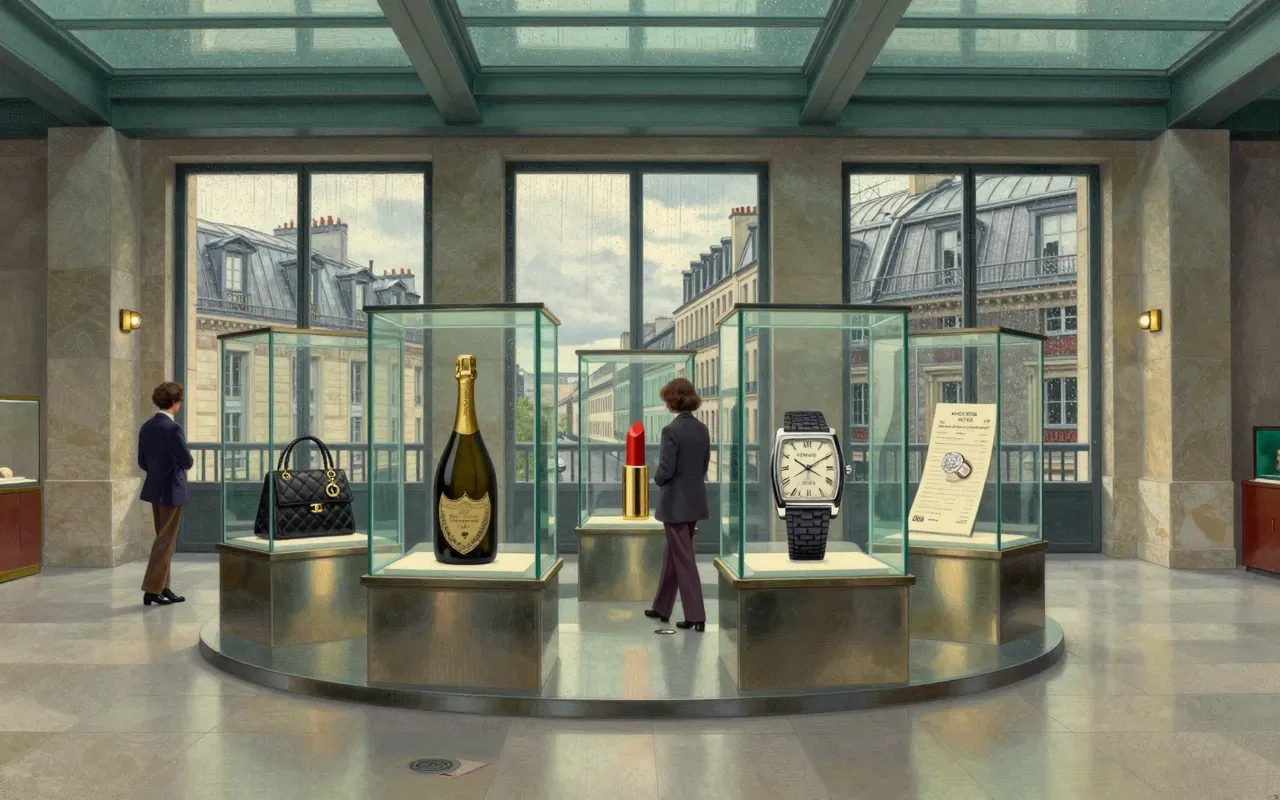
LVMH is a French multinational luxury goods conglomerate formed in 1987 by merger—not founded—of Louis Vuitton and Moët Hennessy. Bernard Arnault assumed control shortly thereafter, not by founding but by outmanoeuvring the initial family owners. The company operates through ~60 subsidiaries managing 75 luxury brands across six branches. Its $500B valuation in April 2023 reflects disciplined acquisition—Boussac Saint-Frères (1984), Tiffany & Co. (2021)—and structural decentralisation that preserves brand identity while centralising financial control. LVMH does not invent luxury; it acquires, integrates, and governs it.

Chapters & takeaways4
  1. 1:04
    Not a founder, but a conqueror

    LVMH was not founded by Bernard Arnault—it was formed by merger in 1987, and he seized control from the original family owners.

  2. 2:32
    Acquisition as calibrated pressure

    Arnault entered luxury via Boussac in 1984—and repeated the play with Tiffany, cancelling then renegotiating the deal to extract leverage during crisis.

  3. 4:17
    Autonomy with strings attached

    Decentralisation is real for branding and creative control—but not for capital, governance, or exit decisions.

  4. 5:46
    Scale without invention

    LVMH’s $500B valuation and eurozone market cap leadership are direct results of its acquisition engine—not organic innovation.

Worth your time?

Yes. Study the whole thing.

4.5/ 5
What works
  • acquisition-discipline
  • capital-allocation
  • brand-sovereignty-model
What does not
  • founder
  • innovator
  • organic-growth
Study it if
  • strategists
  • M&A-practitioners
  • brand-managers
Skip it if
  • designers
  • craft-artisans
  • startup-founders
The written brief1 min read

What the company or idea is

LVMH is a French multinational luxury goods conglomerate formed in 1987 by merger—not founded—of Louis Vuitton and Moët Hennessy.

How it actually makes money

LVMH makes money by owning and operating ~60 subsidiaries that manage 75 luxury brands across six branches: Fashion Group, Wines and Spirits, Perfumes and Cosmetics, Watches and Jewelry, Selective Distribution, and Other Activities.

What works

Arnault’s acquisition discipline works: Boussac Saint-Frères (1984), Tiffany & Co. (2021), and structural decentralisation all delivered measurable outcomes—including $500B valuation in April 2023 and top eurozone market capitalisation.

What does not

LVMH does not create new luxury brands from scratch. It acquires them. Its decentralisation model does not extend to financial control or strategic direction—those remain tightly held by Arnault and the Paris headquarters.

What to take from it

LVMH proves that scale in luxury is not about uniformity but about layered sovereignty: brands retain history and creative identity while surrendering pricing power, capital budgets, and M&A approval to Paris.

Is it worth your time

Yes—if you want to study how a conglomerate extracts value from brand autonomy while centralising capital allocation, governance, and acquisition strategy.

Same desk · Strategy4 of 101
11:24
Aeroplan1984Aeroplan is a loyalty infrastructure, not a brand. Its value was priced at CA$450 million—not for its story, but for its database, redemption control, and embedded position in Canadian banking and retail. It works because it sits between payer and user, extracting margin from both. It fails when ownership drifts and alignment fractures. Its lesson is structural, not inspirational.
10:10
AGCO1990AGCO is a textbook case of consolidation-by-acquisition in mature industrial manufacturing — built on purchased brands, not proprietary R&D.
10:34
Air France1933Air France is the French flag carrier, formed on 30 August 1933 via merger of five airlines. It operates from Charles de Gaulle Airport, served 201 destinations across 78 countries as of 2013, and held a politically critical role in West Berlin from 1950 to 1990. Since 2003, it has been a subsidiary of Air France–KLM — not an independent entity. Its revenue comes from scheduled passenger and cargo services. Its longevity reflects state support and geopolitical utility, not market resilience or innovation.
10:10
Alimentation Couche-TardAlain Bouchard · 1980Alimentation Couche-Tard is a textbook case of geographic and operational scaling through acquisition and banner standardisation — not product, tech, or marketing innovation. Its model depends on acquiring undermanaged regional chains, stripping overlapping functions, and enforcing consistency in procurement and site selection. It reveals little about consumer behaviour or retail design, but much about how capital, real estate leverage, and decentralised execution combine to dominate fragmented markets.
Up next in Business

Mahindra & Mahindra

1945 · 11:44

A steel trader became India’s biggest tractor maker by licensing Jeeps — not by inventing anything.

11:44