What the company or idea is
Mahindra & Mahindra is an Indian automobile and farm equipment manufacturer founded in 1945 as a steel trading company in Ludhiana.
According to Wikipedia, it was founded on 2 October 1945 as Mahindra & Mohammed by the brothers Kailash Chandra Mahindra and Jagdish Chandra Mahindra, with Malik Ghulam Muhammad. In 1948 Ghulam Mohammed moved to the newly formed Pakistan. The Mahindras were left with stationery and a company stamp reading M&M, and without the money to change the name, so they renamed the firm Mahindra & Mahindra, since there were two Mahindra brothers.
How it actually makes money
Mahindra & Mahindra makes money by manufacturing and selling SUVs, tractors, light commercial vehicles, gensets, and military vehicles — with tractors contributing the largest volume globally and SUVs dominating domestic Indian production.
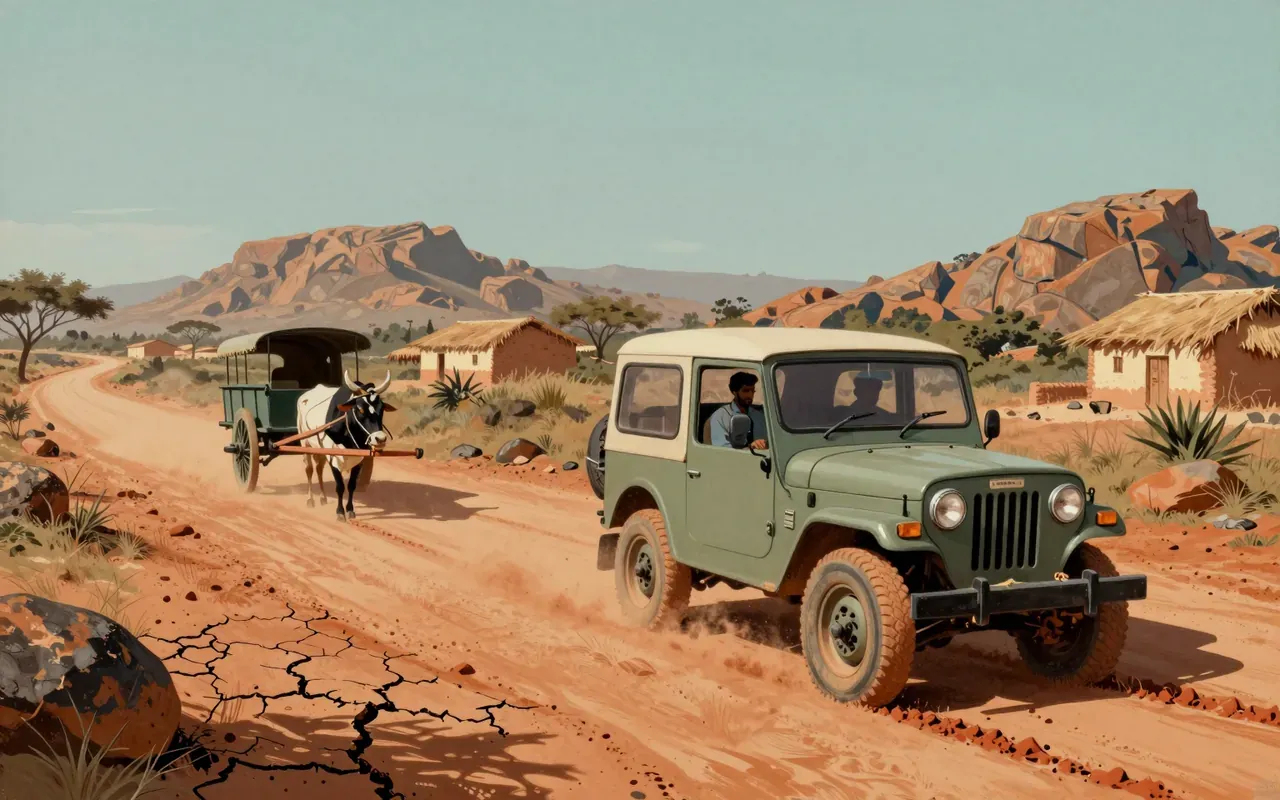
Mahindra began making tractors for the Indian market in the early 1960s and now sells more than 200,000 a year, having sold over 2.1 million in total. Mahindra Tractors has over 1,000 dealers and about 1.45 million customers, sells in 40 countries and builds at four plants in India, two in China, three in the United States and one in Australia. On the vehicle side, it began assembling the Jeep CJ3 in 1954 and light commercial vehicles in 1965. It also ran a genset business, entered in 2002, and built military vehicles from 1947, starting with imported Willys Jeeps.
What works
Its tractor business is the world’s largest by volume; its SUV production is among India’s largest; and its 1984 acquisition of Balkania marked an early, concrete step in overseas expansion — not just branding.
The acquisitions list is long. In 1984 Mahindra bought the Greek vehicle maker Balkania, which had until then produced some Mahindra models under licence. In 1999 Mahindra bought 100% of Gujarat Tractors from the Government of Gujarat. In 2007 it acquired Punjab Tractor Limited, which made it the world’s largest tractor manufacturer, and in 2011 it took a majority stake in South Korea’s SsangYong Motor. In December 2015 Mahindra and Tech Mahindra agreed to buy 76.06% of the Italian designer Pininfarina for €168 million.
What does not
It does not control its own core vehicle platforms: early growth depended entirely on Willys Jeep licensing, and later expansion relied on joint ventures and acquisitions rather than proprietary R&D-led product development.
The picture is more mixed than that. Jeep was bought by American Motors in 1970, and Mahindra kept building Jeeps under licence from AMC and later Chrysler. In 1979 it began licensed assembly of Peugeot diesel engines and transmissions, and in 1982 it announced a tie-up with Kia to build a four-speed transmission. Renault, after a joint venture that ran from 2005 to April 2010, still licenses and supplies key components such as engines and transmissions. But the XUV500, launched in September 2011, is described as designed in-house on the first global SUV platform that could be used for more SUVs.
Some ventures also ran into trouble. SsangYong entered receivership in December 2020 after Mahindra stopped funding it, and a KG Group-led consortium took control in November 2022. Mahindra ended its Ford collaboration in January 2021, citing pandemic-era economic conditions. Its planned North American launch of diesel pickups, around 2010, was indefinitely delayed amid a legal dispute with its distributor, Global Vehicles USA, and in June 2012 its American dealers filed a mass tort lawsuit alleging conspiracy and fraud.
What to take from it
Its trajectory reveals how industrial policy, import substitution, and state-licensed manufacturing shaped private enterprise in India — not founder vision or technology, but access to licences and markets.
Is it worth your time
Yes — as a case study in how a trading firm leveraged licensing, vertical integration, and acquisition to become an industrial anchor in India’s post-colonial economy.