What the company or idea is
AGCO is an American agricultural machinery manufacturer founded in 1990 as a spin-out of Deutz-Allis North America.
It was established on 20 June 1990, when four Deutz-Allis executives bought the North American operations from the parent, the German company Klöckner-Humboldt-Deutz, which owned the Deutz-Fahr brand. The name is a contraction of Allis-Gleaner Corporation. Robert Ratliff was the first chairman, and the company is headquartered in Duluth, Georgia.
How it actually makes money
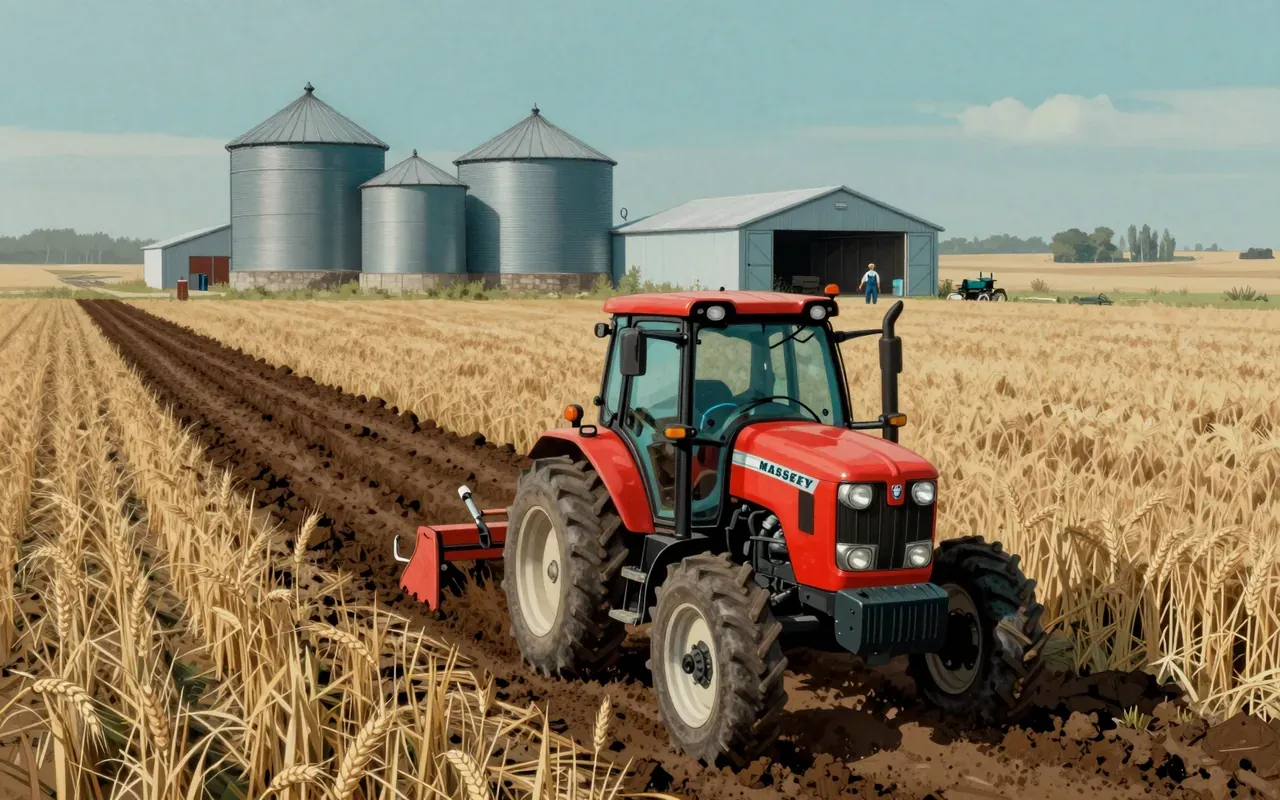
AGCO makes money by designing, producing and selling agricultural machinery — tractors, combines, foragers, hay tools, self-propelled sprayers, seeding equipment, tillage equipment and smart farming technologies.
AGCO assembled its range through acquisitions. The 1993 purchase of White-New Idea brought hay equipment, manure spreaders and planters. The 1995 purchase of AgEquipment Group added tillage equipment and loaders. Ag-Chem Equipment in 2001 expanded application equipment, and the 2002 deal with Caterpillar gave AGCO the Challenger name and high-power tracked tractors. In 2017 it added Precision Planting and the forage machinery line from Lely.
What works
Its 1991 purchase of Hesston gave it hay and forage equipment plus grain auger technology. Its 1993–1994 acquisition of Massey Ferguson gave it 20 percent global tractor market share overnight.
The Massey Ferguson deal came in two steps: the North American distribution rights in 1993, then the company itself from Varity the following year, which gave AGCO access to markets in Europe and around the world. Fendt followed in 1997, and the purchase was contingent on three conditions: the Fendt name would be retained, the Marktoberdorf factory would keep operating, and a fair price would be paid. The 2004 purchase of Valtra, from the Kone Group, brought SISU Diesel engines; before that AGCO had no engine factory of its own and used engines from eight different manufacturers.
What does not
AGCO does not establish a new business model. It relies on inherited brands, distribution rights and bolt-on acquisitions — not proprietary technology or vertical integration.
The brand line-up was later consolidated. In 2006 AGCO announced a refocusing that reduced the number of individual brands, combining some and making others part of a larger brand. In 2001 it merged the AGCO-Allis and White tractor lines in North America under the AGCO brand, and in late 2009 it announced that orange AGCO tractors would be phased out by 2011. The company has also sold parts of itself: in July 2024 it announced an agreement to divest its Grain and Protein divisions, including GSI and Cimbria, to American Industrial Partners.
What to take from it
AGCO shows that market share can be bought — not built — by acquiring established brands with existing customer bases and regional distribution.
Is it worth your time
Yes, if you are studying how industrial incumbents reassemble themselves through acquisition rather than innovation.
More recently it has turned towards technology purchases. It started Fuse Technologies, a smart farming division, in 2013, and under chairman Eric Hansotia bought a series of precision agriculture firms from 2021. Its largest acquisition in company history came in 2024, when it bought 85 percent of Trimble Inc. for US$2 billion; the deal resulted in PTx Trimble, a joint venture for autonomizing and retrofitting farm equipment. Even there, the route to the technology was a purchase.