businessbriefs
12:04in productionCh. 1 · Founding/ 12:04 · ceiling 15 min
Product

JCB (heavy equipment manufacturer)

1945

JCB didn’t disrupt — it filled gaps in metal, hydraulics, and operator workflow.

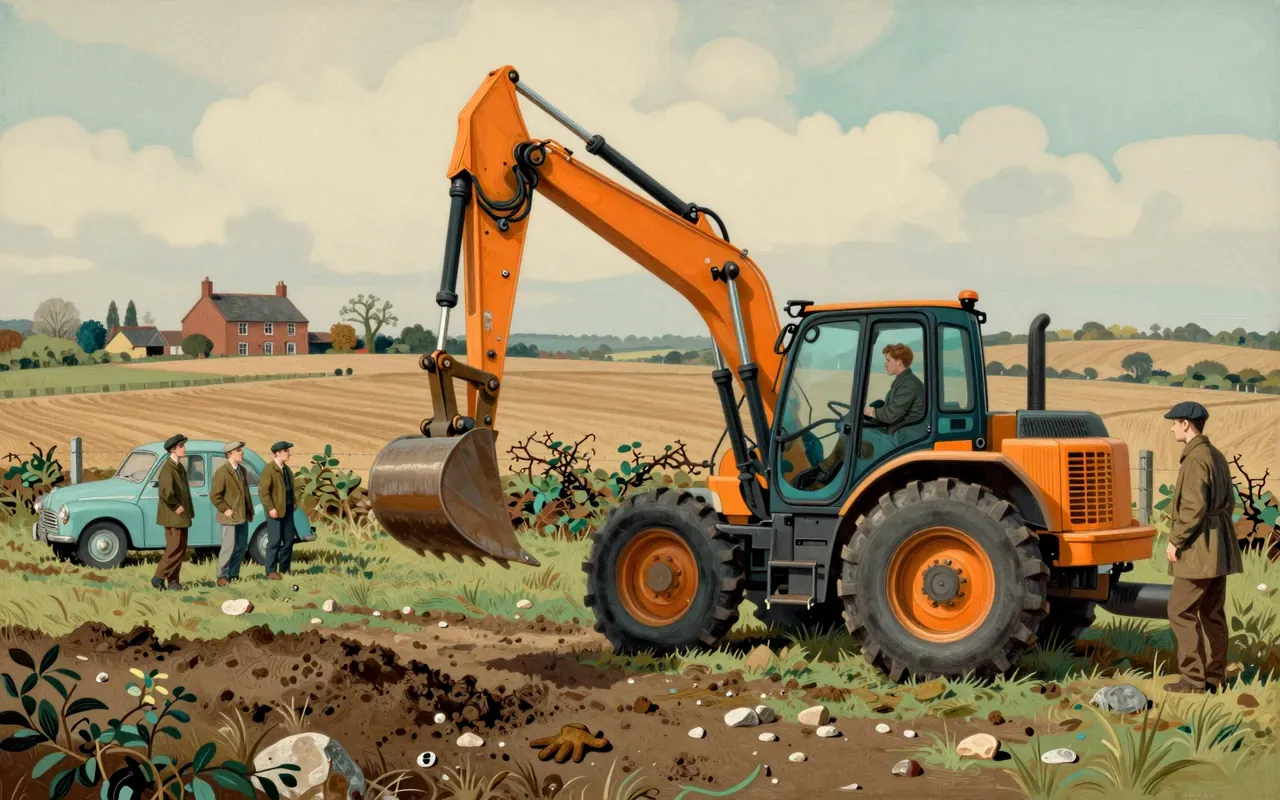
JCB is a British private manufacturer of heavy equipment, founded in 1945. Its early innovations — the 1948 hydraulic tipping trailer, 1953 backhoe loader, and 1957 hydra-digga — solved concrete operator problems in agriculture and construction. It scaled to 3,000+ 3C units by 1964 and expanded globally. But the material reveals nothing about cost, margin, funding, or governance — only what it built, where, and when.

Chapters & takeaways6
  1. 1:11
    Founding

    JCB began as a single-person workshop in Uttoxeter in October 1945.

  2. 2:30
    First Hydraulic Trailer

    In 1948, JCB built Europe’s first hydraulic tipping trailer — with six employees.

  3. 4:02
    First Backhoe Loader

    The 1953 backhoe loader was JCB’s first integrated excavator-loader machine — and the first appearance of the JCB logo.

  4. 5:31
    Hydra-Digga

    The 1957 hydra-digga merged excavator and loader functions into one tool for farm and site work.

  5. 7:24
    Scale: 3,000 Units by 1964

    By 1964, JCB had sold over 3,000 units of its 3C backhoe loader — a sign of repeatable product-market fit.

  6. 8:29
    Global Reach, Private Ownership

    JCB remains a privately owned British multinational — with operations in India, the US, Brazil, China, and Russia.

Worth your time?

Yes. Study the whole thing.

4/ 5
What works
  • first-mover product integration
  • repeatable unit sales (3,000+)
  • geographic expansion without public disclosure of financing
What does not
  • margin
  • funding source
  • customer acquisition cost
  • R&D expenditure
Study it if
  • industrial designers
  • mechanical engineers
  • manufacturing strategists
Skip it if
  • venture investors
  • marketing executives
  • platform analysts
The written brief1 min read

What the company or idea is

JCB is a British multinational private company founded in 1945 by Joseph Cyril Bamford in Uttoxeter, Staffordshire, producing equipment for construction, agriculture, waste handling, and demolition.

How it actually makes money

JCB makes money by manufacturing and selling heavy equipment for construction, agriculture, waste handling, and demolition.

What works

Its first-mover timing in Europe (1948, 1953, 1957), clear product naming (3C, JCB 7), and geographic expansion into India, the US, Brazil, China, and Russia indicate scalable execution — but the material gives no evidence of how that expansion was funded or governed.

What does not

The material says nothing about margins, pricing, cost structure, customer acquisition, or who bears the capital cost of R&D — so none of those can be assessed.

What to take from it

JCB’s early product milestones — the 1948 hydraulic tipping trailer, 1953 backhoe loader, and 1957 hydra-digga — show a pattern of integrating functions to serve real operator needs, not chasing novelty for its own sake.

Is it worth your time

Yes — it is a rare case of sustained, self-funded industrial innovation rooted in mechanical problem-solving, not financial engineering or platform logic.


Same desk · Product4 of 26
10:56
ABBCharles Eugene Lancelot Brown · 1988ABB is a post-merger industrial incumbent whose value lies in proven, regulated, physical infrastructure — not software, platforms, or scalability stories.
11:35
BiogenCesar Milstein · 1978Biogen is a neurology-focused biotech that built scale via acquisition, not foundational science — and César Milstein, whose hybridoma work underpins modern antibody therapeutics, has no documented relationship to the company.
10:34
Enphase Energy2006Enphase Energy is a hardware-first energy technology company that built market position by solving a specific, observable failure in residential solar—central inverter underperformance—then scaling through successive generations of microinverters. Its business model relies entirely on third-party installers and distributors. It has no recurring revenue stream, no customer-facing software layer, and no ownership of energy generation. Its success reflects disciplined component-level innovation—not ecosystem control.
10:16
First SolarHarold McMaster · 1999First Solar is a U.S. solar panel manufacturer that builds cadmium telluride (CdTe) thin-film modules in domestic factories. It was founded in 1990 as Solar Cells, Inc. by Harold McMaster, acquired and rebranded in 1999, and went public in 2006. Its technology diverges from mainstream silicon PV. As of March 2026, it had ~14 GW of annual domestic nameplate capacity across facilities in Ohio, Alabama, and Louisiana. It does not produce silicon panels, does not operate overseas factories, and does not integrate storage or software.
Up next in Business

JD.com

Richard Liu · 2004 · 10:38

JD.com didn’t win China’s e-commerce war with algorithms — it won with warehouses, call centres, and a 2003 SARS loss that forced it offline.

10:38