11:07in productionCh. 1 · Motion is the enemy/ 11:07 · ceiling 15 min
Ideas · Management
Assembly line
The assembly line is not innovation — it is enforced discipline disguised as progress.
The assembly line is a method, not a business. Its value is in enforced sequencing — not novelty. It lowers labour cost by removing motion, not people. Its constraints (precedence, cycle time) are features, not bugs. It fails where variation, repair, or rework enters the process. Worth studying for how it reveals the cost of standardisation — not for how it ‘disrupted’ anything.
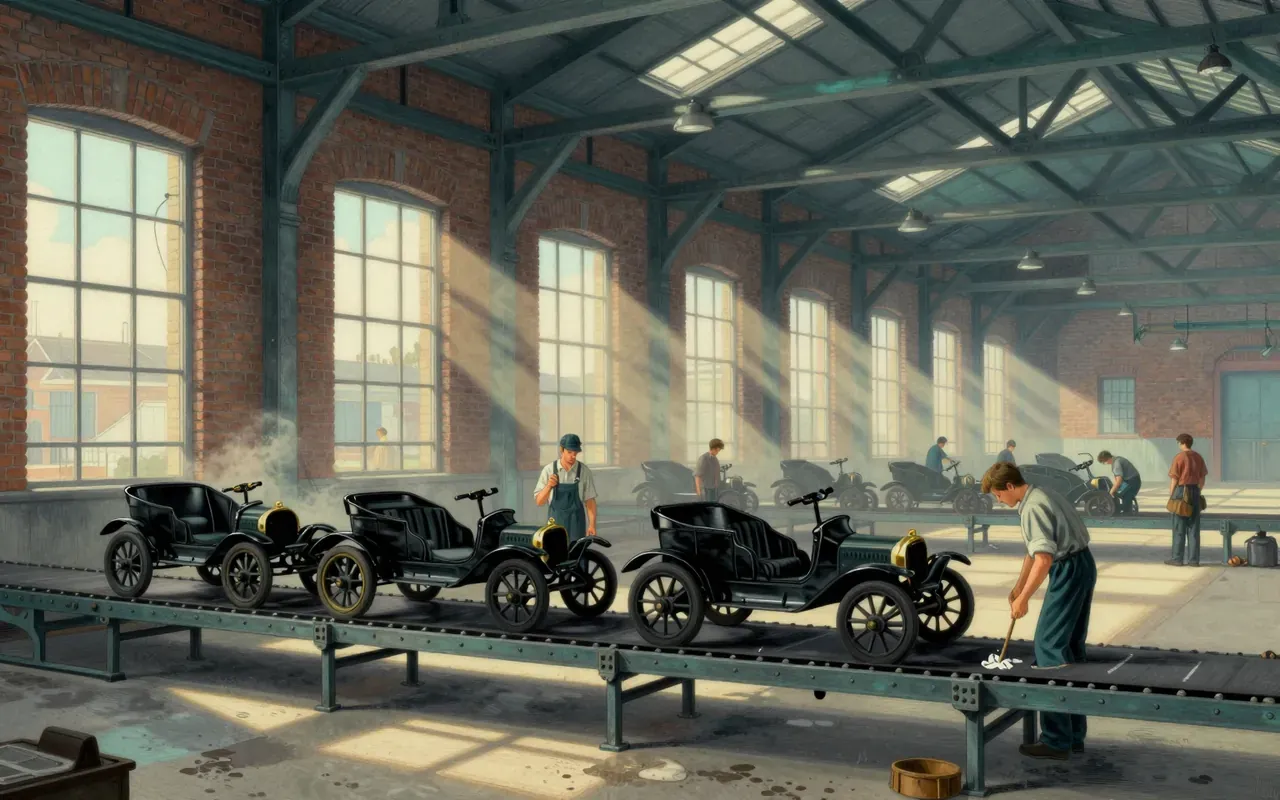
It moves the product, not the people — and every motion is designed out.
2:30
Who pays for the lift?
Labour cost falls because transport and lifting are automated — not because workers are replaced.
3:43
The tyranny of cycle time
Every station obeys two laws: what must come before, and how long you have to do it.
5:06
Complexity with constraints
It only works for complex items with stable designs — cars, not software; appliances, not art.
6:31
Before Highland Park
Ford did not invent it — he industrialised its movement. The first flow line ran in Suffolk in 1853.
7:39
The worker as slot
Assemblers are not operators or engineers — they are nodes in a sequence, defined by one action.
Worth your time?
Yes. Study the whole thing.
4.5/ 5
What works
Reduces unit labour cost by eliminating manual transport and heavy lifting.
Enables precise measurement of task time and bottleneck location.
Standardises output where design and parts are stable.
What does not
It does not scale to bespoke or low-volume production.
It does not reduce quality risk — it hides defects until final inspection.
It does not improve worker retention — monotony and pace drive turnover.
Study it if
Manufacturers with stable, high-volume product lines.
Students of operations research or lean production.
Policy makers assessing labour displacement in industrial policy.
Skip it if
Startups building digital products.
Service businesses.
Organisations prioritising craft or customisation.
The written brief1 min read
What the company or idea is
The assembly line is a sequential, mechanised manufacturing method. It moves unfinished products between workstations while adding parts in order. It is not a firm, brand, or technology vendor.
How it actually makes money
The assembly line does not make money. It is a method, not a company. It reduces labour cost and increases output speed — lowering unit cost for manufacturers who adopt it.
What works
Mechanically moving parts and products between stations cuts labour and boosts speed. Assigning one simple operation per worker — with conveyors, gravity, or motorised handling — minimises motion and standardises output.
What does not
It does not eliminate skill, adaptability, or human judgment. It assumes stable demand, predictable parts, and fixed product design — all of which break down with customisation, obsolescence, or supply volatility.
What to take from it
Its power lies in constraint: cycle time and precedence graphs force clarity on task duration and dependency. That rigidity enables measurement, replication, and cost control — but also locks in assumptions about what can be built, and how fast.
Is it worth your time
Yes, if you are evaluating how production systems shape cost, labour, or scalability — especially where physical goods are made at scale.