businessbriefs
9:42in productionCh. 1 · Origin: From NOVA to Novafinivest to Novatek/ 9:42 · ceiling 15 min
Companies

Novatek

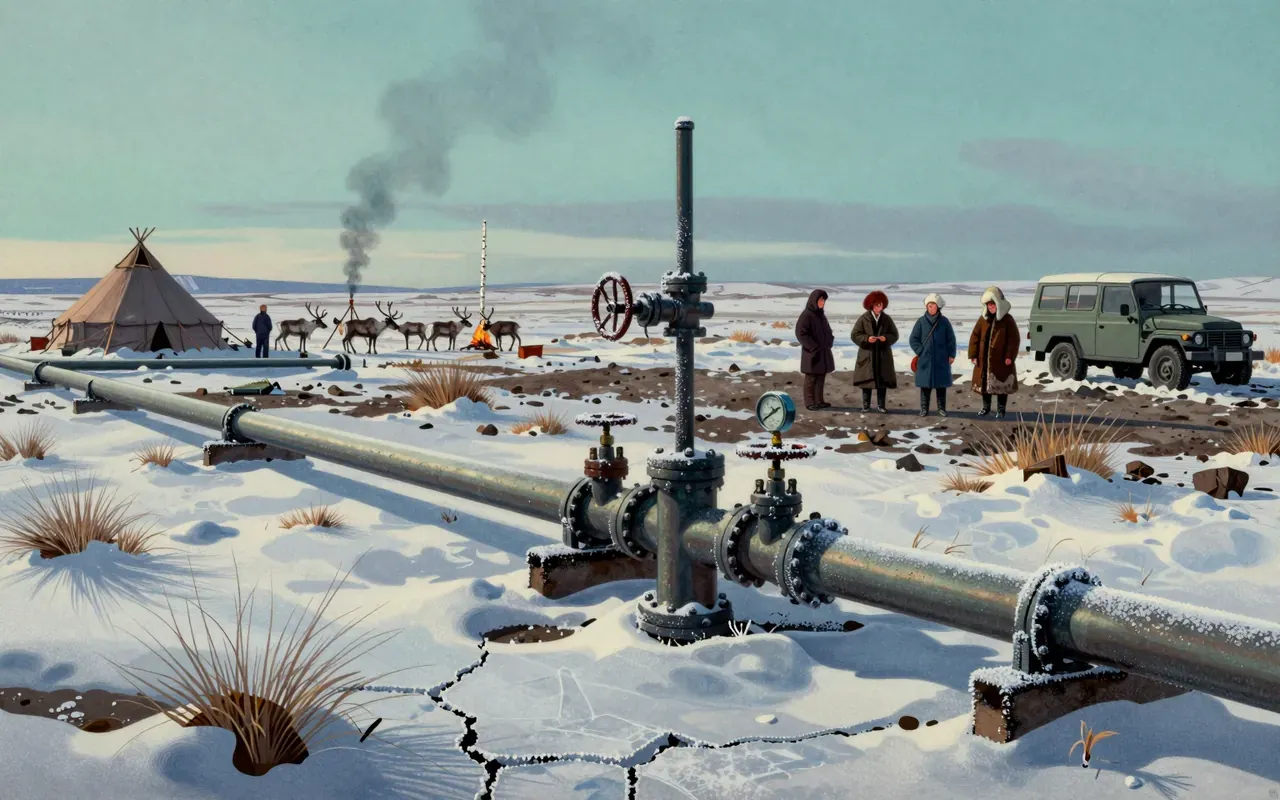
Novatek grew fast—but only because it was the only private gas firm allowed to sell domestically at Gazprom’s shadow prices.

Novatek is a state-tolerated gas monopoly-in-waiting: dominant domestically, absent internationally, priced by regulation not competition.

Chapters & takeaways4
  1. 1:02
    Origin: From NOVA to Novafinivest to Novatek

    Novatek is Russia’s second-largest gas producer—and emerged directly from a Soviet pipeline builder’s privatisation in 1994.

  2. 2:34
    Growth: Domestic-only, geography-bound, volume-driven

    It built scale in Yamalo-Nenets, doubling production in five years without entering export or LNG markets.

  3. 4:02
    Market: Captive, constrained, and uncompetitive on price

    Its 13% domestic market share came from operating solely in the low-price dry gas segment—no diversification, no pricing leverage.

  4. 5:46
    Ownership & Reserves: Concentrated control, regulatory methodology

    Majority control rests with Mikhelson and Timchenko; reserves are large but SEC-validated—not independently audited or production-tested.

Worth your time?

Yes. Study the whole thing.

3.5/ 5
What works
  • domestic scale-up under price controls
  • reserve volume validation via SEC methodology
  • infrastructure-rooted vertical integration
What does not
  • LNG exports
  • international sales
  • price-setting power
  • diversified revenue streams
Study it if
  • students of post-Soviet industrial policy
  • analysts of state-market hybrid models
  • investors assessing reserve-to-production ratios under SEC rules
Skip it if
  • those seeking innovation in energy tech
  • global commodity traders
  • ESG-focused capital allocators
The written brief1 min read

What the company or idea is

Novatek is Russia’s second-largest natural gas producer, formed in 1994 from Novafinivest—the holding company of pipeline builder NOVA—and controlled by Leonid Mikhelson and Gennady Timchenko.

How it actually makes money

Novatek makes money selling dry natural gas exclusively in Russia’s domestic market, where prices are artificially low.

What works

Vertical integration from pipeline construction roots gave it control over infrastructure access in Yamalo-Nenets. Its reserve base (9.4 billion BOE SEC) supports sustained production, and its 32% share of non-Gazprom output confirms structural position as Russia’s only alternative gas supplier.

What does not

It does not operate outside the domestic dry gas market. It has no stated LNG export revenue, no international sales footprint, and no pricing power beyond the regulated Russian wholesale system.

What to take from it

Its growth—30 bcm in 2006 to 52.9 bcm in 2011—was achieved entirely inside a captive, low-price domestic market, not through competitive differentiation or global access.

Is it worth your time

Yes—if you are studying how state-adjacent resource firms scale within price-controlled markets while avoiding export exposure.
Same desk · Companies4 of 224
9:55
All Nippon AirwaysYoshida Shoji · 1952ANA is Japan’s largest airline, rooted in a 1952 helicopter-and-aeroplane transport company. It launched Japan’s first postwar scheduled flight by a Japanese pilot in December 1953, added passenger service on the Osaka–Tokyo route in February 1954, and scaled into a dominant domestic carrier. Its growth reflects regulatory privilege more than competitive differentiation. No financials, pricing, or cost structure are disclosed in the source material.
9:32
E.LeclercÉdouard Leclerc · 1948E.Leclerc is a French retailers’ cooperative founded in 1948. It pioneered the hypermarket format in 1964, adopted self-service retailing from the Félix Potin model, launched wine fairs in 1973, discontinued disposable plastic bags in 1996, introduced the Repère brand in 1997, and expanded internationally starting with Pamplona in 1992 and most recently into Luxembourg in 2023 via acquisition.
8:42
MagnitSergei Galitskiy · 1994Magnit is a Russian food retailer founded in 1994 in Krasnodar by Sergey Galitsky. It grew rapidly from a regional chain into a national leader, adopting the convenience store format in 2004 and expanding to 1,000 stores by 2000 and 1,500 by 2005—surpassing Pyaterochka in revenue. By 2010 it ranked among the world’s top 250 retailers (Deloitte), and in 2014 became Russia’s largest importer. Its growth continued with milestones including 10,000 stores (2015), entry into pharmacy and drogerie formats, and strategic acquisitions like Dixy (2021) and Samberi (2024). Ownership shifted significantly after 2018, with Marathon Group becoming the largest shareholder in November 2021. Management transitioned from Galitsky to external CEOs starting in 2018, and the company pursued vertical integration via in-house production facilities and distribution infrastructure.
10:37
OMVHans Susta · 1956OMV is Austria’s major integrated oil- and gas company, founded in 1956 as the successor to the Soviet Mineral Oil Administration in occupied Austria. It makes money from refining crude oil at Schwechat, importing oil via the Adria–Vienna Pipeline from Trieste, selling natural gas supplied under contract with the Soviet Union, and operating transit infrastructure like the Trans-Austria Gas Pipeline. Its vertical integration worked: Schwechat refinery (1960), Soviet gas supply (1968), Adria–Vienna Pipeline (1970), and Trans-Austria Gas Pipeline (1974) formed a self-reinforcing system that locked in Austria’s role as a Central European energy node. OMV’s foundational model does not address decarbonisation, renewable generation, or energy storage. Its 1956–1974 expansion relied entirely on fossil fuel import, processing, and transit — with no indication of diversification beyond that scope in the source material. OMV shows how a national energy company can be built not through innovation or market creation, but through sequential infrastructure capture: refinery, pipeline, gas contract, transit corridor — each reinforcing the others’ value. Yes — as a case study in state-origined energy integration, infrastructure-led regional positioning, and Cold War-era resource diplomacy. Not as a model for modern energy transition strategy.
Up next in Business

Novo Nordisk

1923 · 10:34

Novo Nordisk is not a biotech disruptor — it is the institutional heir to Denmark’s 1920s insulin labs, built on merger, not molecule.

10:34