businessbriefs
12:17in productionCh. 1 · What it was/ 12:17 · ceiling 15 min
Finance · Rise & fall

J.P. Morgan & Co.

1871

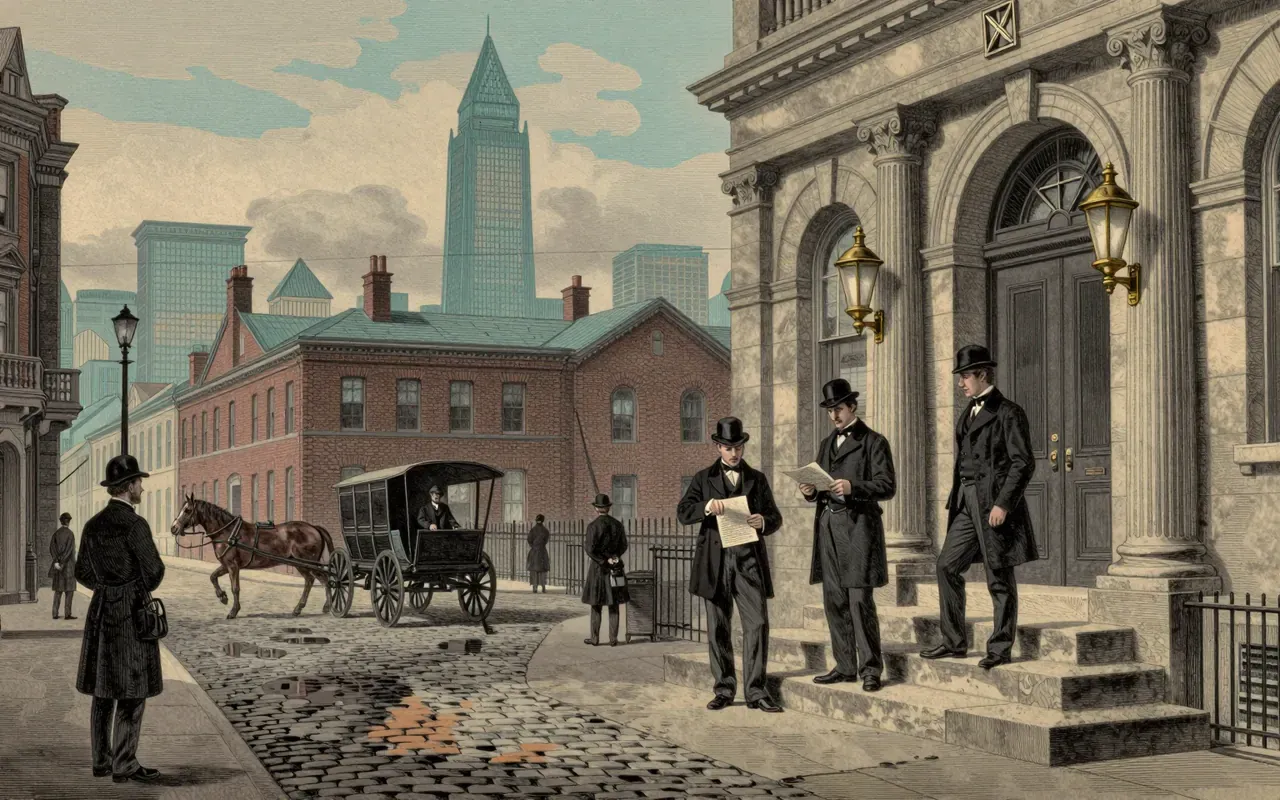
J.P. Morgan & Co. didn’t build markets — it owned the door.

J.P. Morgan & Co. was a gatekeeping financial institution whose power derived from scarcity of trusted intermediaries — not technology, scale, or consumer reach. Its business model collapsed when regulation severed its integrated banking functions, and its legacy survives only as a brand within a merged entity.

Chapters & takeaways4
  1. 1:20
    What it was

    It was founded in 1871 as a specialist investment bank — not a universal bank, not a startup, not a tech platform.

  2. 3:25
    How it got paid

    It financed railroads and bailed out the U.S. Treasury — extracting fees and control, not equity stakes or software royalties.

  3. 5:06
    The sovereign mandate

    In 1914, it became the sole underwriter for British and French war bonds — a monopoly granted by the Bank of England, not won in competition.

  4. 6:59
    The regulatory fracture

    Glass–Steagall didn’t disrupt it — it revealed that its dual-banking model was legally contingent, not structurally durable.

Worth your time?

Yes. Study the whole thing.

4.5/ 5
What works
  • as a masterclass in institutional leverage
  • in revealing how sovereign trust substitutes for competition
  • through its documented, non-anecdotal mechanics
What does not
  • innovation
  • consumer-facing
  • technology-driven
Study it if
  • historians of finance
  • regulators
  • deal-makers studying gatekeeping
Skip it if
  • founders seeking growth playbooks
  • product managers
  • marketing strategists
The written brief1 min read

What the company or idea is

J.P. Morgan & Co. was a New York–based investment bank founded in 1871, specialising in asset management, private banking, and investment banking — not a diversified financial conglomerate until long after its founding.

How it actually makes money

J.P. Morgan & Co. made money by underwriting securities, arranging loans, and managing capital for industrial firms, governments, and allied war efforts — charging fees and spreads on bond issues, syndicated loans, and advisory services.

What works

Its model worked where sovereigns and corporations lacked alternative capital sources — as with the 1895 U.S. Treasury rescue and the 1914–1918 Allied war financing — turning scarcity of trusted intermediaries into pricing power.

What does not

It did not sustain integrated commercial and investment banking after 1933; the Glass–Steagall Act forced separation, exposing its dependence on legal permission to combine functions.

What to take from it

Its influence came from acting as gatekeeper: controlling access to capital for railroads, governments, and nations at war — not from building products or serving consumers.

Is it worth your time

Yes — as a case study in how financial power is built through regulatory arbitrage, sovereign trust, and concentrated dealmaking, not innovation or scale.

Same desk · Finance4 of 39
10:53
Apollo Global ManagementLeon Black · 1990Apollo Global Management is a $1.03 trillion alternative asset manager built on distressed-to-control investing, co-founded in 1990 by ex-Drexel bankers. It earns fees from pension funds, endowments, and sovereign wealth funds deploying capital across credit, private equity, and real assets. Its model works at scale—but its credibility fractures where leadership conduct contradicts its governance claims. The $158 million paid to Jeffrey Epstein did not disrupt operations, but it ended Leon Black’s tenure and exposed a rift between Apollo’s discipline-as-brand and its human risk.
10:30
Sam Bankman-FriedFTX was not a failed startup. It was a financial structure built to move value across unregulated jurisdictions without transparency — and it succeeded until it ran out of other people’s money to move.
10:03
BATS Global Markets2005BATS Global Markets was a stock exchange operator founded in June 2005 in Lenexa, Kansas. It became a licensed US stock exchange operator in 2008 and launched a pan-European market the same year. As of February 2016, it operated four US stock exchanges, two US equity options exchanges, the pan-European stock market, and a global foreign exchange market. It was acquired by Cboe Global Markets in 2017.
10:42
Blackstone Inc.Stephen Schwarzman · 1985Blackstone is the largest alternative investment firm by AUM — $1.2 trillion as of September 2025, $1.3 trillion by Q1 2026 — built on a pivot from M&A advisory to merchant banking in 1987. Its founders lacked LBO experience but leveraged relationships to enter private equity, then scaled across asset classes using consistent mechanics: leverage, illiquidity, and fee-based capital aggregation. Its CEO held formal advisory access to the U.S. presidency, but that did not substitute for early fundraising credibility. The firm discloses neither performance nor risk metrics for its funds. Its growth reflects structural demand — not proprietary insight.
Up next in Business

Morris Chang

· 10:33

He didn’t bet on Asia — he measured yield in Texas and Japan, then moved the factory.

10:33