businessbriefs
11:16in productionCh. 1 · A Mandate, Not a Movement/ 11:16 · ceiling 15 min
Finance

National Stock Exchange of India

1992

A state-backed exchange beat India’s oldest bourse not by being better at finance — but by refusing to let brokers gatekeep the market.

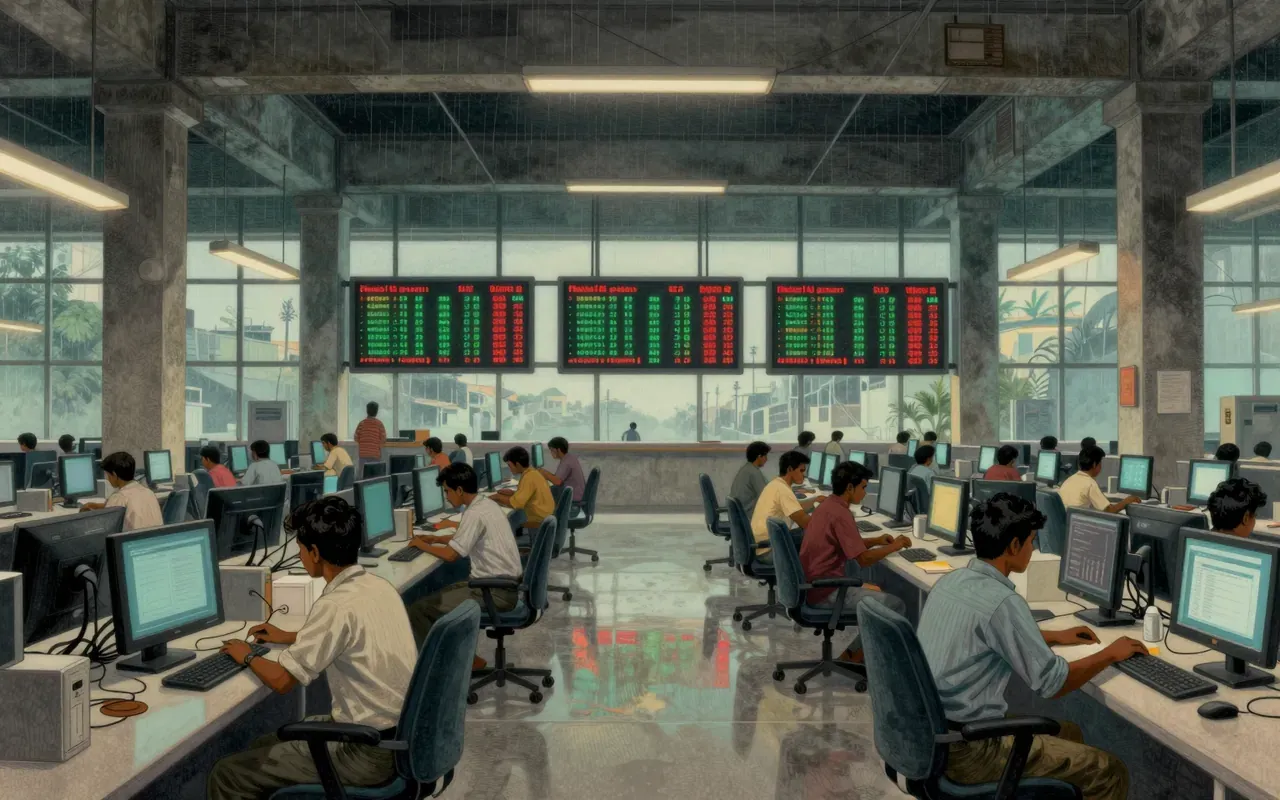
NSE was a technologically enabled, state-directed institutional intervention — not a market-driven innovation — that redefined access to India’s equity markets by design, not accident.

Chapters & takeaways4
  1. 0:55
    A Mandate, Not a Movement

    NSE was not a startup — it was a government-directed institutional reset built on a 1991 committee’s blueprint.

  2. 2:51
    First in Tech, Not Just Timing

    Electronic trading wasn’t a feature — it was the entry condition. NSE launched with WDM on 30 June 1994 and equities on 3 November.

  3. 4:54
    No Brokers, No Barriers

    Membership was open to anyone qualified and financially sound — breaking the BSE’s closed broker club.

  4. 6:39
    Overtaken in Twelve Months

    Within one year, NSE’s daily turnover exceeded BSE’s — proof that structural access beats incumbency.

Worth your time?

Yes. Study the whole thing.

4/ 5
What works
  • replacing broker gatekeeping with merit-based access
  • deploying electronic trading before any domestic rival
  • achieving volume leadership within twelve months
What does not
  • how NSE sustains its dominance after 1995
  • its fee structure or profitability
  • whether PSU ownership dilutes accountability
Study it if
  • policy designers
  • market infrastructure operators
  • regulators studying institutional competition
Skip it if
  • investors seeking financial metrics
  • founder-led startup analysts
  • venture capital researchers
The written brief1 min read

What the company or idea is

NSE is an Indian stock exchange headquartered in Mumbai, incorporated in 1992 as a PSU joint venture to bring transparency to equity markets, following the Pherwani committee’s 1991 recommendations.

How it actually makes money

NSE makes money from transaction fees, listing fees, data licensing, and market infrastructure services — but the sources do not specify revenue streams, pricing, margins, or cost structure.

What works

NSE worked because it launched electronic trading before any Indian exchange, opened membership to all qualified individuals, and overtook BSE in daily turnover within one year of operations.

What does not

The sources do not establish how NSE sustains its competitive position beyond its first year, nor do they show whether its ownership model (banks, insurance companies, PSUs) creates conflicts of interest or constrains innovation.

What to take from it

Institutional reform can succeed when it decouples market access from inherited status — but only if the underlying governance and incentives remain aligned with that mission.

Is it worth your time

Yes — as a case study in state-led institutional design that bypassed entrenched incumbents by prioritising access, technology, and transparency over legacy privilege.


Same desk · Finance4 of 40
10:53
Apollo Global ManagementLeon Black · 1990Apollo Global Management is a $1.03 trillion alternative asset manager built on distressed-to-control investing, co-founded in 1990 by ex-Drexel bankers. It earns fees from pension funds, endowments, and sovereign wealth funds deploying capital across credit, private equity, and real assets. Its model works at scale—but its credibility fractures where leadership conduct contradicts its governance claims. The $158 million paid to Jeffrey Epstein did not disrupt operations, but it ended Leon Black’s tenure and exposed a rift between Apollo’s discipline-as-brand and its human risk.
10:30
Sam Bankman-FriedFTX was not a failed startup. It was a financial structure built to move value across unregulated jurisdictions without transparency — and it succeeded until it ran out of other people’s money to move.
10:03
BATS Global Markets2005BATS Global Markets was a stock exchange operator founded in June 2005 in Lenexa, Kansas. It became a licensed US stock exchange operator in 2008 and launched a pan-European market the same year. As of February 2016, it operated four US stock exchanges, two US equity options exchanges, the pan-European stock market, and a global foreign exchange market. It was acquired by Cboe Global Markets in 2017.
10:42
Blackstone Inc.Stephen Schwarzman · 1985Blackstone is the largest alternative investment firm by AUM — $1.2 trillion as of September 2025, $1.3 trillion by Q1 2026 — built on a pivot from M&A advisory to merchant banking in 1987. Its founders lacked LBO experience but leveraged relationships to enter private equity, then scaled across asset classes using consistent mechanics: leverage, illiquidity, and fee-based capital aggregation. Its CEO held formal advisory access to the U.S. presidency, but that did not substitute for early fundraising credibility. The firm discloses neither performance nor risk metrics for its funds. Its growth reflects structural demand — not proprietary insight.
Up next in Business

NextEra Energy

1925 · 11:48

The world’s largest renewable generator still gets more than a third of its power from fossil fuels—and that’s the point.

11:48