businessbriefs
10:22in productionCh. 1 · State Creation, Not Market Entry/ 10:22 · ceiling 15 min
Rise & fall · Strategy

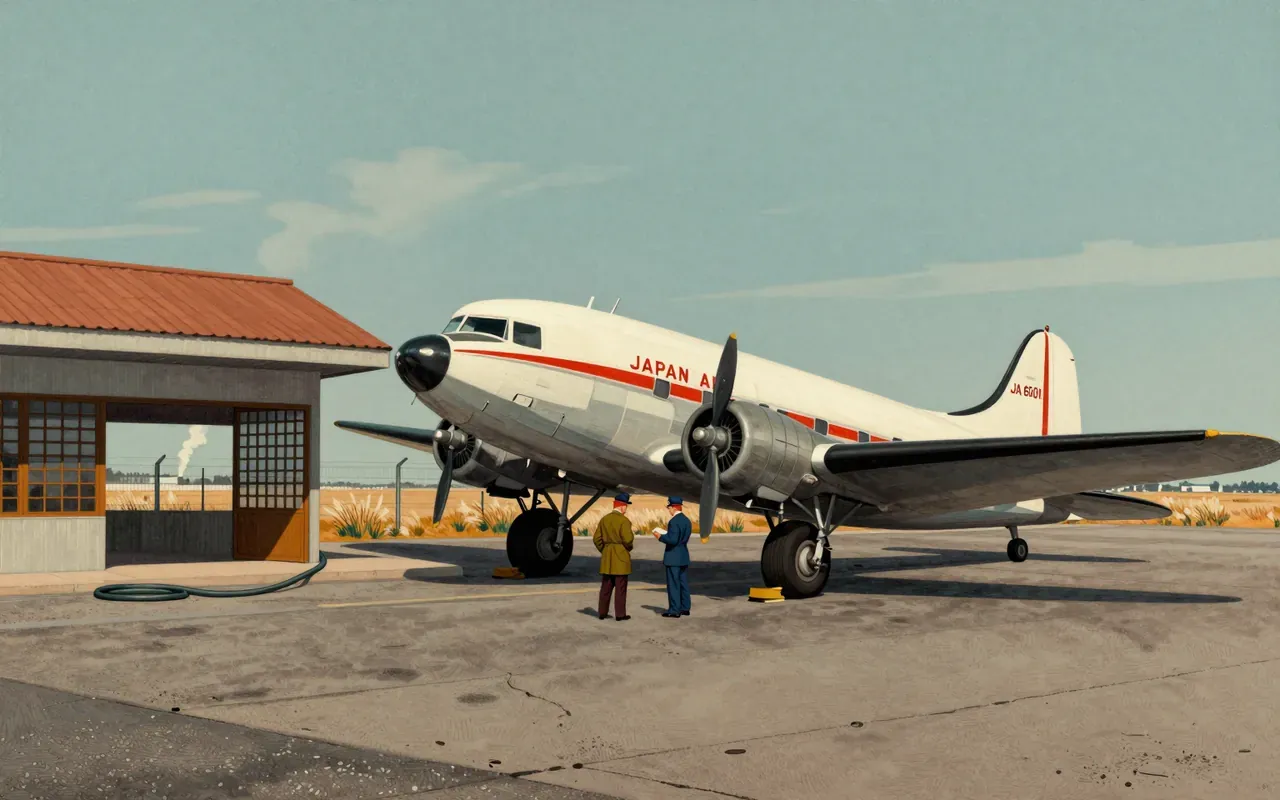
Japan Airlines

1951

A national airline built for recovery became a cautionary tale about scale without sovereignty over its own balance sheet.

Japan Airlines is a state-created instrument of post-war recovery that became a national carrier, then a global-scale operator, then a bankrupt entity restructured into a publicly traded airline. Its history reveals how political mandate, legislative design, and financial exposure interact — not as a story of disruption or innovation, but of institutional endurance under shifting ownership and crisis.

Chapters & takeaways5
  1. 1:10
    State Creation, Not Market Entry

    JAL was not a startup but a sovereign instrument: created by the Japanese government on 1 August 1951 to restore air connectivity after WWII.

  2. 2:16
    Legislated National Carrier

    In 1953, the National Diet replaced its private form with a new state-owned structure — formalising JAL as Japan’s national airline.

  3. 3:17
    Size Without Sovereignty

    The 2002 merger with Japan Air System delivered global scale — sixth-largest by passengers — but no structural immunity from financial shock.

  4. 4:26
    Restructuring as Reset, Not Rescue

    Bankruptcy in 2010 was followed by rapid restructuring — returning to profitability and the Tokyo Stock Exchange in 2011.

  5. 5:59
    Network Built on Two Logics

    Today’s JAL group operates passenger and cargo services across 220 destinations in 35 countries — a network built on state foundations and market adaptation.

Worth your time?

Yes. Study the whole thing.

4/ 5
What works
  • as a template for public-private transition
  • as evidence that scale ≠ stability
  • as a record of legislative scaffolding for infrastructure
What does not
  • disrupt
  • innovate
  • found a new category
Study it if
  • airline operators
  • state-owned-enterprise strategists
  • restructuring practitioners
Skip it if
  • startup founders
  • VC investors
  • product managers
The written brief1 min read

What the company or idea is

Japan Airlines is a major Japanese airline founded on 1 August 1951 as a government-owned business to rebuild air transport after World War II.

How it actually makes money

Japan Airlines makes money from scheduled and non-scheduled international and domestic passenger and cargo services across 220 destinations in 35 countries.

What works

Its 2010–2011 restructuring returned it to profitability and relisting on the Tokyo Stock Exchange — proving its operational model could survive radical financial surgery.

What does not

Scale did not protect it: merging with Japan Air System in 2002 made it the world’s sixth-largest airline by passengers carried, yet it filed for bankruptcy in 2010 after the 2008 financial crisis.

What to take from it

Its trajectory shows that national carrier status, size, and global reach do not insulate an airline from balance-sheet fragility when cost structures, ownership models, and external shocks misalign.

Is it worth your time

Yes — as a case study in state-owned enterprise formation, post-crisis restructuring, and the limits of scale without structural resilience.

Same desk · Rise & fall4 of 32
9:32
Alfa RomeoNicola Romeo · 1910Alfa Romeo was not founded by Nicola Romeo. It was founded in 1910 as A.L.F.A. to acquire the assets of the failing Italian Darracq subsidiary. Romeo acquired it in 1915, took full ownership by 1918, renamed it in 1920, launched the first Alfa Romeo-branded car in 1921, won the inaugural 1925 World Manufacturers’ Championship, faced near-liquidation in 1927 due to poor investments, departed formally in 1928, and was taken over by the Italian state in 1933.
9:47
Merger of AOL and Time WarnerThe AOL–Time Warner merger was a $180 billion acquisition led by AOL — the smaller, less profitable company — based solely on its inflated market valuation. It closed on 11 January 2001 after regulatory approval but generated no meaningful synergy. It produced a $99 billion loss in 2003, triggered debt-driven divestitures, abandoned the AOL brand by late 2003, and culminated in AOL’s spin-off in December 2009. It stands as a definitive case of valuation masquerading as strategy.
9:47
Bombardier Inc.1942Bombardier Inc. is a Canadian manufacturer founded in 1942 in Valcourt by Joseph-Armand Bombardier to market his snowmobiles. It diversified into public transport vehicles and commercial jets during the 1970s and 1980s. Its turnover multiplied sixfold within six years at the end of the 1980s. At that time, it was North America's most important producer of railway vehicles, Canada's most important aerospace manufacturer, and the worldwide leading snowmobile maker. It is headquartered in Montreal.
11:47
CitroënAndré-Gustave Citroën · 1919Citroën was a French automobile manufacturer founded in 1919 in Saint-Ouen-sur-Seine. It pioneered four world-first production car technologies: front-wheel drive with unibody construction (1934), hydropneumatic self-levelling suspension (1954), modern disc brakes (1955), and swiveling headlights (1967). It also launched the 2CV in 1948, pioneering soft interconnected suspension. Citroën gained international reputation mass-producing armaments in WWI. It became the fourth-largest carmaker in the world in the 1930s, peaking in 1932 with the Traction Avant. Cost struggles aggravated by the Great Depression led to bankruptcy in 1934 and takeover by Michelin. Its double-chevron logo derived from André Citroën’s application of double helical gears, which he acquired after seeing them used by a Polish carpenter around 1900.
Up next in Business

Japan Exchange Group

2013 · 11:51

Japan Exchange Group is not a disruptor — it is the state-enforced consolidation of Japan’s exchange infrastructure.

11:51