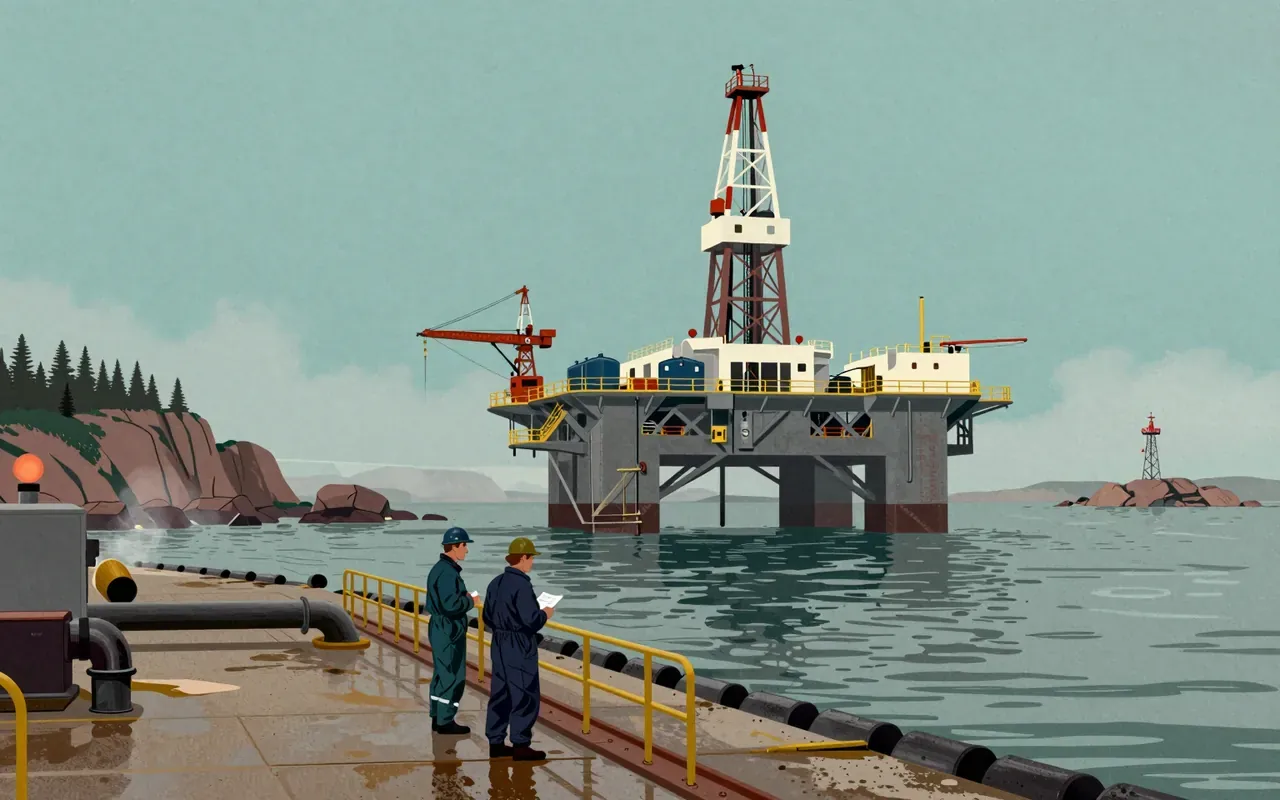
Imperial Oil was founded in 1880 as a Canadian response to Standard Oil’s expansion — a deliberate replication of Rockefeller’s integrated model. It quickly controlled 85% of national refining capacity. After failing to secure British ownership, its board sold 75% to Standard Oil in 1898, absorbing its Canadian subsidiaries. Post-1911 antitrust breakup, Imperial remained legally distinct but was wholly assigned to Jersey Standard — becoming Standard Oil’s exclusive vehicle for Canadian operations.
Imperial Oil was founded not as an innovation, but as a mirror — a Canadian imitation of Rockefeller’s model, built to fight Standard Oil by copying it.
3:00
Scale Before Sovereignty
It achieved dominance fast: twelve refineries, 85% of Canada’s refining capacity, and a charter mandating control over the full petroleum chain from wellhead to pump.
4:24
The Sale That Wasn’t a Surrender
After failing to sell to a British firm, Imperial’s board chose Standard Oil — handing over 75% ownership while absorbing Standard Oil’s Canadian subsidiaries.
6:36
One Entity, Two Countries
Post-1911, Imperial remained whole — assigned exclusively to Jersey Standard, making it the only Standard Oil successor with uninterrupted Canadian jurisdiction.
1 more chapterFewer chapters
Worth your time?
Yes. Study the whole thing.
4.5/ 5
What works
Its founding charter enabled full vertical integration.
Its scale — twelve refineries, 85% of national refining capacity — gave it immediate leverage.
Its post-acquisition centralisation in Sarnia improved operational efficiency.
What does not
It did not remain independent.
Its attempt to secure British ownership failed.
Its founders’ ambition to merge the entire Canadian oil industry was overtaken by U.S. capital — not through competition, but acquisition.
Study it if
Historians of energy policy
Students of antitrust and corporate structure
Analysts of cross-border industrial integration
Skip it if
Those seeking evidence of Canadian industrial autonomy
Those looking for a story of entrepreneurial disruption
Who should study it, and who should skipHide who it is for
The written brief1 min read
What the company or idea is
Imperial Oil was a Canadian petroleum conglomerate founded in 1880 as a defensive, Rockefeller-style consolidation of domestic refiners in London and Petrolia, Ontario.
How it actually makes money
Imperial Oil made money by controlling 85% of Canada’s refining capacity and integrating upstream-to-downstream operations — finding, producing, refining, and distributing petroleum across the country.
What works
Its founding charter enabled full vertical integration. Its scale — twelve refineries, 85% of national refining capacity — gave it immediate leverage. Its post-acquisition centralisation in Sarnia improved operational efficiency.
What does not
It did not remain independent. Its attempt to secure British ownership failed. Its founders’ ambition to merge the entire Canadian oil industry was overtaken by U.S. capital — not through competition, but acquisition.
What to take from it
The gap between nationalist industrial strategy and transnational capital control is visible here: Imperial was built to resist Standard Oil, then became its designated Canadian arm — intact in name, subordinate in substance.
Is it worth your time
Yes — it is a rare documented case of a national industrial consolidation explicitly modelled on Rockefeller’s system, then absorbed into it on terms that preserved its legal form while surrendering control.