businessbriefs
12:56in productionCh. 1 · From forks to factories/ 12:56 · ceiling 15 min
Companies

Hero MotoCorp

Hero MotoCorp didn’t disrupt two-wheelers—it licensed its way to dominance, then rebranded its way out of dependency.

Hero MotoCorp is a case study in state-enabled industrial scaling: it leveraged licences, joint ventures, and low-cost execution—not proprietary tech or global branding—to become India’s dominant two-wheeler maker. Its independence from Honda was real, but its post-2011 growth relies on the same mechanics: volume, distribution, and incremental product iteration.

Chapters & takeaways6
  1. 1:22
    From forks to factories

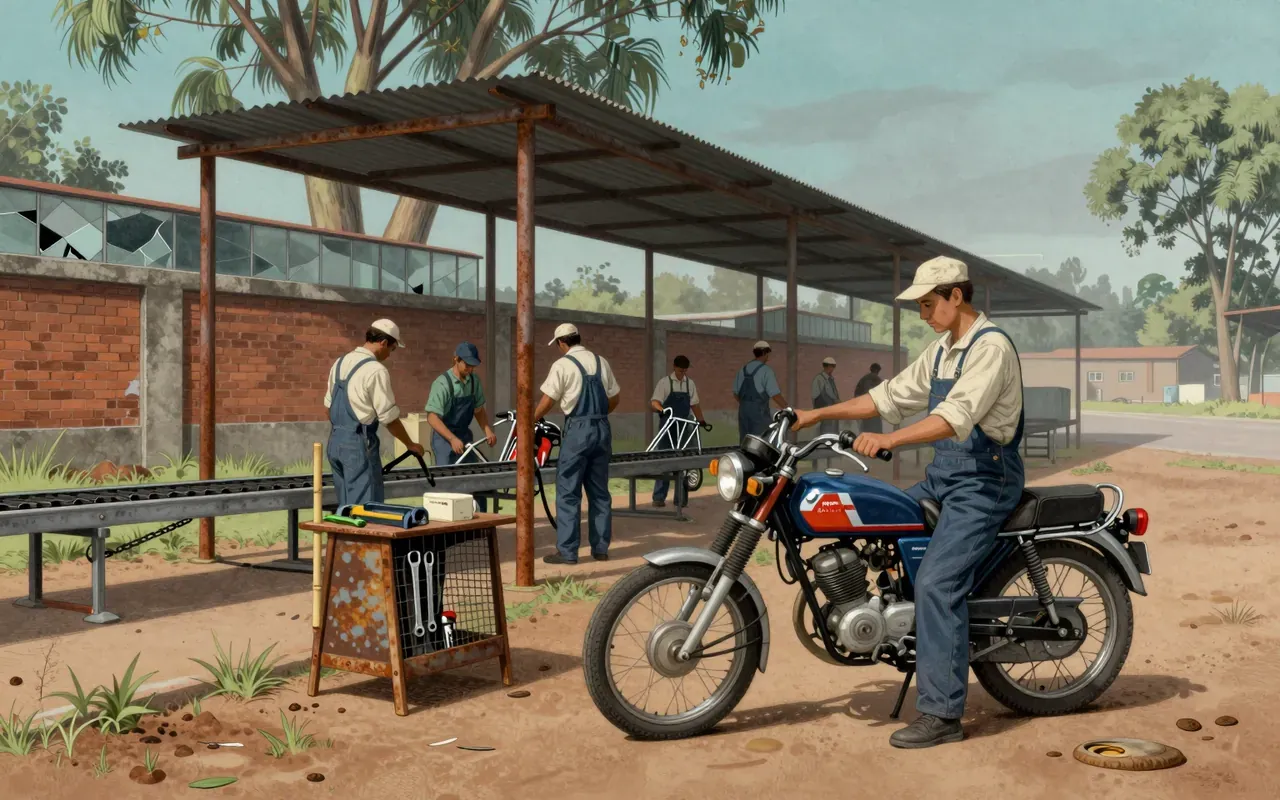
    It began as a bicycle parts maker, scaled via government licence, then entered two-wheelers with Hero Majestic before the Honda JV.

  2. 2:39
    The Honda leverage

    The 1984 Hero Honda joint venture delivered low-cost motorcycles—and by 2001, market leadership.

  3. 4:01
    The clean break

    In December 2010, the board chose exit. On 29 July 2011, it became Hero MotoCorp—and gained new export markets.

  4. 5:22
    Scale without sovereignty

    It dominates India with ~30% share—but that dominance was built on bicycles first, then Honda, not internal IP.

  5. 6:53
    Where the margins go

    Low cost defined its domestic rise; export expansion followed separation—but no verified evidence confirms competitive advantage abroad.

  6. 8:27
    The first balance sheet

    Its early capital came from Rs 6 lakh in government support and its own funds—its 7,500-bicycle capacity was the first factory floor it owned.

Worth your time?

Yes. Study the whole thing.

3.5/ 5
What works
  • scale-through-licensing
  • state-market-coordination
  • manufacturing-discipline
What does not
  • electric-vehicles
  • innovation
  • global-branding
Study it if
  • industrial-strategists
  • emerging-market-manufacturers
  • licensing-analysts
Skip it if
  • tech-startup-founders
  • VC-investors-seeking-disruption
  • brand-theorists
The written brief1 min read

What the company or idea is

Hero MotoCorp is an Indian multinational motorcycle and scooter manufacturer headquartered in Delhi, founded in 1984 as Hero Honda—a joint venture between Hero Cycles and Honda.

How it actually makes money

Hero MotoCorp makes money by manufacturing and selling motorcycles and scooters in India and internationally. It holds about 30% of the Indian two-wheeler market. Its revenue comes from volume sales, not premium pricing or services.

What works

Its low-cost motorcycle strategy in the 1980s captured mass-market demand. Its bicycle origins gave it manufacturing discipline, distribution muscle, and capital to fund the two-wheeler pivot. By 2001, it was India’s largest two-wheeler manufacturer.

What does not

It does not control its own powertrain IP at scale. After exiting Honda, it gained export rights to Latin America, Africa, and West Asia—but no evidence shows it built competitive R&D or supply-chain autonomy in electric mobility or engines.

What to take from it

Its success rests on timing, government licence access, and Honda’s technology transfer—not innovation or brand-led disruption. The separation from Honda was strategic autonomy, not technological self-sufficiency.

Is it worth your time

Yes—if you want to understand how a domestic industrial champion scales through licensing, joint ventures, and sovereign market access, then pivots to independence without collapsing.

Same desk · Companies4 of 217
12:57
MeituanWang Xing · 2010Meituan is a Chinese technology company headquartered in Beijing that operates a platform for local services, including on‑demand food delivery, in‑store services, consumer reviews under Dazhong Dianping, hotel and travel bookings, and instant retail. It monetises through fees on its platform, taking a commission on food delivery orders and charging merchants for booking and in‑store services. Meituan’s rapid user growth is driven by its extensive coverage of local services, its integration of food delivery, in‑store services, and hotel bookings creating a one‑stop shop, and its large merchant base of 14.5 million active merchants providing network effects. Meituan faces regulatory scrutiny in China, its 2021 post by Wang Xing triggered a 7.1 % share plunge and anti‑monopoly investigation, and the company has been subject to scrutiny by Beijing Municipal Human Resources and Social Security Bureau. Meituan demonstrates the power of a diversified local‑services platform, its ability to scale across cities and internationally shows the importance of network effects, and its regulatory challenges highlight the need for compliance awareness. Meituan offers a case study in rapid scaling and diversification, but its regulatory risks caution investors.
10:56
ABBCharles Eugene Lancelot Brown · 1988ABB is a post-merger industrial incumbent whose value lies in proven, regulated, physical infrastructure — not software, platforms, or scalability stories.
10:50
AbbVie2012AbbVie is a textbook example of post-innovation pharmaceutical value extraction — built on a single blockbuster, sustained by patent thickets and pricing, checked only by biosimilars and congressional scrutiny.
11:08
Abu Dhabi National Oil Company1971ADNOC is the state-owned oil company of Abu Dhabi, UAE — founded by concession in 1939, ranked 12th globally by production, and expanding output to 5 million barrels per day by 2027. It is the UAE’s largest oil company. Output rose from ~2.5 mbpd in the 1990s to 2.9 mbpd in 2008 and 4.85 mbpd in 2024. It is described as efficient and well managed, but financially opaque. It is one of few oil companies increasing production amid climate pressure.
Up next in Business

Hindustan Unilever

1933 · 10:07

A 90-year-old FMCG giant built on Indian soil — but still answers to London and Rotterdam, not Kodaikanal.

10:07