businessbriefs
9:09in productionCh. 1 · The $100 Ferry/ 9:09 · ceiling 15 min
Founders

Cornelius Vanderbilt

He didn’t disrupt transport — he dismantled state monopolies to seize control of it.

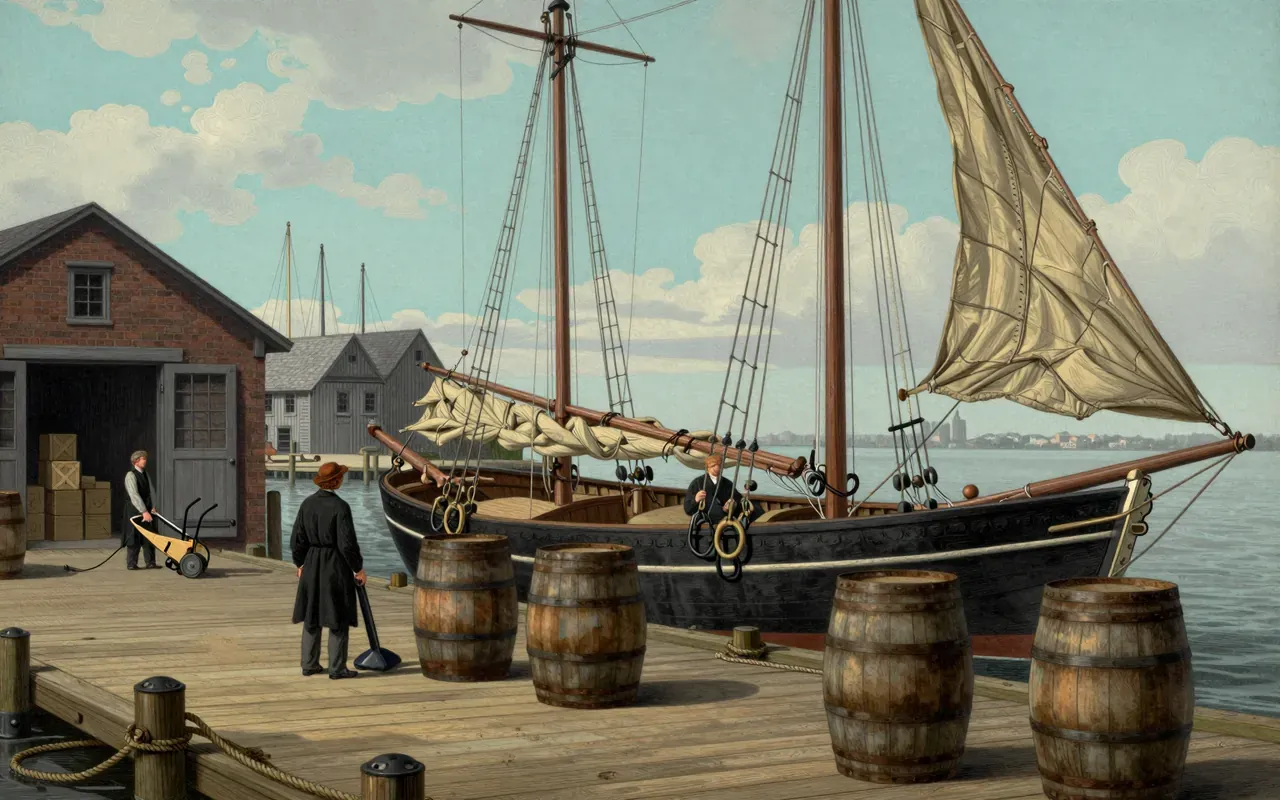
Cornelius Vanderbilt built wealth by moving freight and passengers across water and land — first via ferry, then rail — using legal challenge, borrowed capital, and operational discipline. The sources confirm no revenue figures, no organisational structure, no labour model, and no valuation. His story is one of infrastructure control, not innovation.

Chapters & takeaways4
  1. 1:22
    The $100 Ferry

    He started with $100 borrowed from his mother to run a ferry between Staten Island and Manhattan.

  2. 2:45
    The Monopoly Case

    He joined a campaign against a state steamboat monopoly and paid for Daniel Webster to argue it before the Supreme Court.

  3. 4:27
    The Apprenticeship

    He learned to operate a large, complicated business while working for Gibbons — not as an owner, but as an operator.

  4. 5:47
    The Railroad Shift

    He moved from inland and coastal shipping into railroads — not as a technologist, but as a consolidator of infrastructure.

Worth your time?

Yes. Study the whole thing.

4.5/ 5
What works
  • shows how legal strategy was a core business function
  • reveals capital leverage before formal venture finance
  • exposes the gap between state-granted privilege and federal commerce power
What does not
  • business/deals-and-ipos
  • business/startups-and-venture
  • business/marketing
  • business/product
Study it if
  • people studying how regulatory power shapes markets
  • people analysing pre-corporate wealth formation
  • people comparing 19th-century infrastructure control to modern platform dominance
Skip it if
  • people seeking startup playbooks
  • people looking for founder psychology or leadership frameworks
  • people interested in financial metrics or growth curves
The written brief1 min read

What the company or idea is

Cornelius Vanderbilt was not a company. He was an individual operator who built personal wealth through transport infrastructure — first ferries, then railroads — using legal challenge, capital leverage, and operational scale.

How it actually makes money

He made money by operating ferries, breaking state-granted shipping monopolies, and later consolidating and running railroads.

What works

He used borrowed capital at 16 to launch a ferry service; learned large-scale operations under Gibbons; hired Daniel Webster to argue before the Supreme Court; and moved decisively from water to rail as the dominant transport technology.

What does not

The sources say nothing about his management systems, cost structures, labour practices, or how he funded railroads beyond initial capital. There is no data on margins, headcount, or valuation.

What to take from it

His career shows that regulatory arbitrage — exploiting gaps between state-granted privilege and federal constitutional authority — was a core engine of early American capital accumulation.

Is it worth your time

Yes — it reveals how monopoly-busting, legal strategy, and vertical control of transport infrastructure built industrial-scale wealth in the 19th century.

Same desk · Founders4 of 20
9:16
Liliane BettencourtLiliane Bettencourt was not a founder, operator, or marketer — she was a dynastic shareholder who treated L'Oréal as a financial instrument to be preserved, exchanged, and insulated. Her story reveals how concentrated ownership functions when decoupled from management, branding, or public narrative.
10:22
Rupert MurdochRupert Murdoch built a global media empire by treating national media regulations as code to be patched — acquiring papers opportunistically, relocating physically to meet ownership rules, renouncing citizenship to enter US broadcasting, and standardising tabloid formats to maximise circulation. His method was not technological or creative but jurisdictional and operational: he consolidated printing plants to break unions, adopted electronic publishing not for quality but for control, and turned scandal and sport into repeatable, scalable content units. The gap between his self-presentation as a global communicator and his actual practice — regulatory arbitrage, labour suppression, format standardisation — is the core of the brief.
10:44
Biz StoneBiz Stone is a creative founder whose verified contributions are specific and narrow: design leadership at Xanga, co-founding Twitter and holding its patent, launching Jelly, and returning to Twitter without documented impact. None of his ventures show evidence of revenue generation, unit economics, or scalable business design under his direct control.
10:02
Peter ThielThiel is a founder who treats money, data, and education as broken systems—and replaces them with proprietary alternatives. His ventures share a method: early, decisive capital deployment to technically rigorous teams. But his stated mission—to escape currency devaluation—contradicts the dollar-based economics of every exit, investment, and contract he has overseen.
Up next in Business

Virgin Media

1984 · 11:01

Virgin Media isn’t a telecoms brand — it’s a cable infrastructure play disguised as a consumer service.

11:01