businessbriefs
11:24in productionCh. 1 · The Denny's Bet/ 11:24 · ceiling 15 min
Companies · Strategy

Nvidia

Nvidia didn’t build an AI empire — it rented one, using gaming GPUs as collateral.

Nvidia is a fabless semiconductor company whose business model depends on external demand shocks, not internal cost control or manufacturing leverage.

Chapters & takeaways4
  1. 1:03
    The Denny's Bet

    Nvidia was founded at a Denny's in San Jose — not as a vision of AI, but as a gamble on real-time 3D graphics.

  2. 2:54
    Near-Bankruptcy Was the Business Model

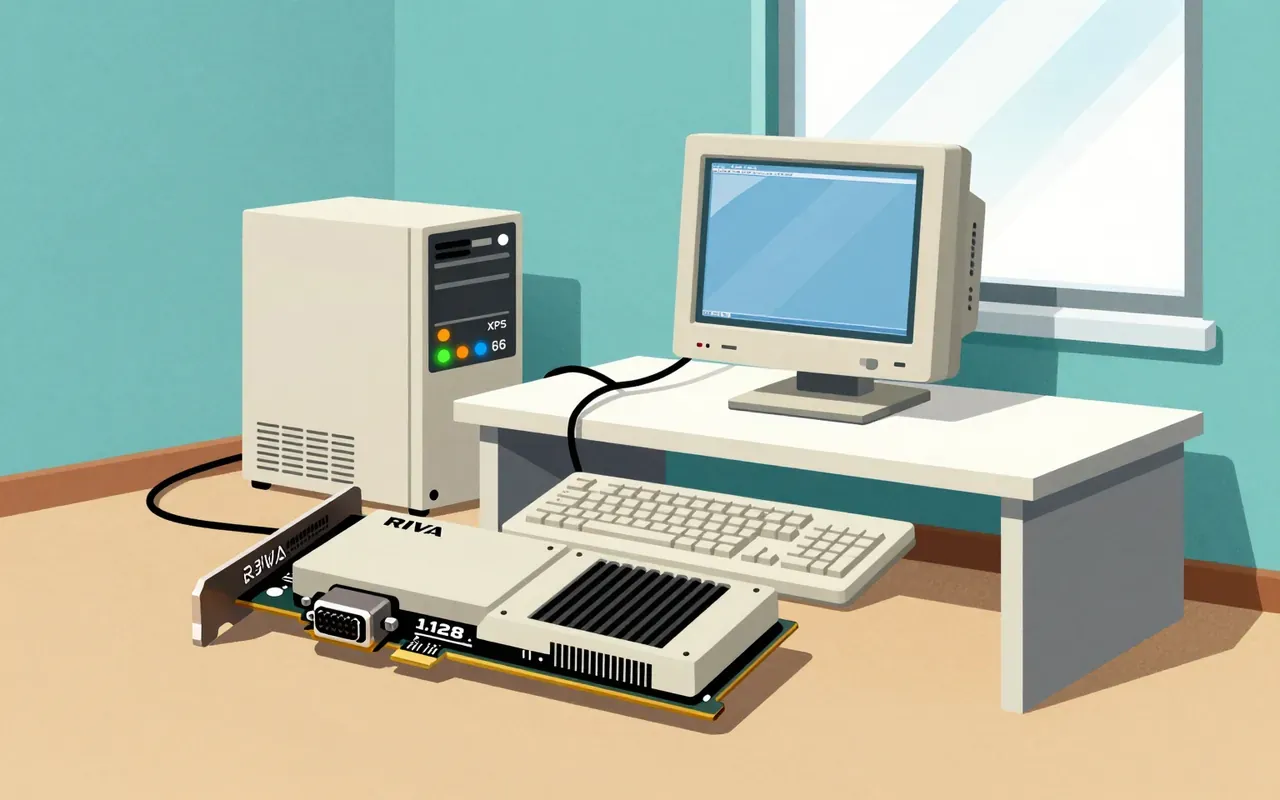
    Its first chips rendered quadrilaterals; its survival hinged on a $5M Sega lifeline and the RIVA 128 launch when payroll had one month left.

  3. 3:58
    Full-Stack Is a Software Layer, Not a Supply Chain

    It calls itself 'full-stack', but sells chips and APIs — not servers, not OSes, not foundry capacity.

  4. 6:04
    Dominance Without Sovereignty

    92% GPU market share and $5T market cap are outcomes — not evidence of control over pricing, production, or roadmaps.

Worth your time?

Yes. Study the whole thing.

4/ 5
What works
  • exposes the gap between 'full-stack' rhetoric and fabless reality
  • shows how timing and external catalysts outweigh operational discipline
  • grounds valuation in observable market share, not hype
What does not
  • treat funding rounds as results
  • invent financial figures
  • praise without mechanism
Study it if
  • product managers assessing platform risk
  • investors evaluating capital intensity
  • engineers studying architectural lock-in
Skip it if
  • founders seeking a blueprint for bootstrapping
  • policy makers looking for antitrust levers
  • students needing financial literacy examples
The written brief1 min read

What the company or idea is

Nvidia is an American semiconductor company founded in 1993 in San Jose, California, by Jensen Huang, Chris Malachowsky, and Curtis Priem. It designs GPUs, SoCs, and APIs — originally for video games, later for AI, supercomputing, and professional visualisation.

How it actually makes money

Nvidia makes money by selling discrete GPUs for gaming, data centres, and professional workstations — plus associated software, licensing, and systems — with no verified revenue, margin, or cost structure disclosed in the sources.

What works

Its GPU architecture became the de facto standard for parallel compute workloads. Its 92% discrete desktop and laptop GPU market share as of Q1 2025 confirms lock-in at the consumer and developer level. Its pivot from rendering primitives to AI acceleration was enabled by sustained software investment and ecosystem capture — not just chip performance.

What does not

Nvidia does not own its manufacturing. It does not design full end-user devices. It does not disclose unit economics, R&D spend, or gross margins. Its ‘full-stack’ claim is aspirational: it controls silicon and software layers but relies entirely on third-party foundries, OEMs, and cloud providers for scale and distribution.

What to take from it

Nvidia’s trajectory shows how a narrow technical bet — triangles over quadrilaterals — combined with near-death timing (RIVA 128, 1997) and external catalysts (AI boom) can override structural weaknesses in capital intensity, fabrication dependency, and customer concentration.

Is it worth your time

Yes, if you need to understand how a hardware company leveraged a single architectural advantage into market dominance — but not as a model of sustainable moat-building, because its position rests on rapid, externally driven demand shifts rather than internal pricing power or vertical control.


Same desk · Companies4 of 164
Up next in Business

OpenAI

Sam Altman & others · 2015 · 9:58

A public benefit corporation whose nonprofit owns less than a third of it—and whose $852bn valuation rests on access, not accounts.

9:58