businessbriefs
9:56in productionCh. 1 · What it is/ 9:56 · ceiling 15 min
Scandals

Telemadrid

1989

A public broadcaster that swapped editorial independence for political utility—and paid for it in audience, credibility, and legality.

Telemadrid is a regional public broadcaster whose history reveals how statutory independence erodes without governance teeth. It launched in 1989 as a cultural experiment but became a partisan instrument under PP leadership after 2003—triggering audience collapse, legal sanctions, and factual breaches. Its partial recovery post-2017 came only after structural reform and distancing from direct political control. It survives not because it innovates, but because it remains locally rooted—and because its failures are instructive.

Chapters & takeaways4
  1. 1:15
    What it is

    Telemadrid is the flagship channel of RTVM, launched on 2 May 1989.

  2. 2:58
    Origins under fire

    It began under PSOE leadership, occupied EFE buildings, and survived a live-broadcast GRAPO attack with no casualties.

  3. 4:22
    Infrastructure and inflection

    It moved to Ciudad de la Imagen in 1997 and pivoted to digital broadcasting in 2001—the year its governing entity changed course.

  4. 5:57
    Flagship ≠ independent

    Its status as RTVM’s flagship channel never shielded it from being repurposed as a partisan tool.

Worth your time?

Yes. Study the whole thing.

3.5/ 5
What works
  • local relevance
  • structural resilience (survived financial crisis, pandemic, political assault)
  • post-2017 audience recovery
What does not
  • audience trust
  • editorial independence
  • legal compliance (laOtra 2006)
  • factual accuracy (2004 documentary)
Study it if
  • public media scholars
  • regulatory watchdogs
  • regional governance analysts
Skip it if
  • investors
  • advertisers
  • content licensing buyers
The written brief1 min read

What the company or idea is

Telemadrid is the flagship public television channel of Radio Televisión Madrid (RTVM), launched on 2 May 1989 under PSOE regional president Joaquín Leguina.

How it actually makes money

Telemadrid is funded by the regional government of the Community of Madrid, not advertising or subscription revenue.

What works

Its local focus on madrileños’ lives—through news, sport, children’s programming and cultural formats—has endured. After 2017, audience share rose three years consecutively to 6.3% in 2020, aided by a restructured newscast service and a shift away from overt political propaganda.

What does not

It does not operate as an independent public service. Its editorial output repeatedly contradicted verified facts, notably on the 2004 Madrid bombings and Catalonia’s language policy, and its second channel laOtra broadcast without legal authority in 2006.

What to take from it

Its trajectory shows that statutory independence means nothing without structural safeguards—like the 2015 two-thirds board endorsement rule—and that audience trust collapses when journalism serves party over evidence.

Is it worth your time

Yes—if you want to study how public broadcasters become political instruments, then falter, then recalibrate under pressure.
Same desk · Scandals4 of 15
9:15
EnronKenneth Lay & Jeffrey Skilling · 1985Enron was an American energy, commodities and services company founded in 1985 through a merger. It grew into a major electricity, natural gas, communications, and pulp and paper company — then collapsed due to institutionalised, systematic accounting fraud. Its 2001 bankruptcy was the largest fraud-related bankruptcy in U.S. history. It reorganised as Enron Creditors Recovery Corp. in 2004.
10:16
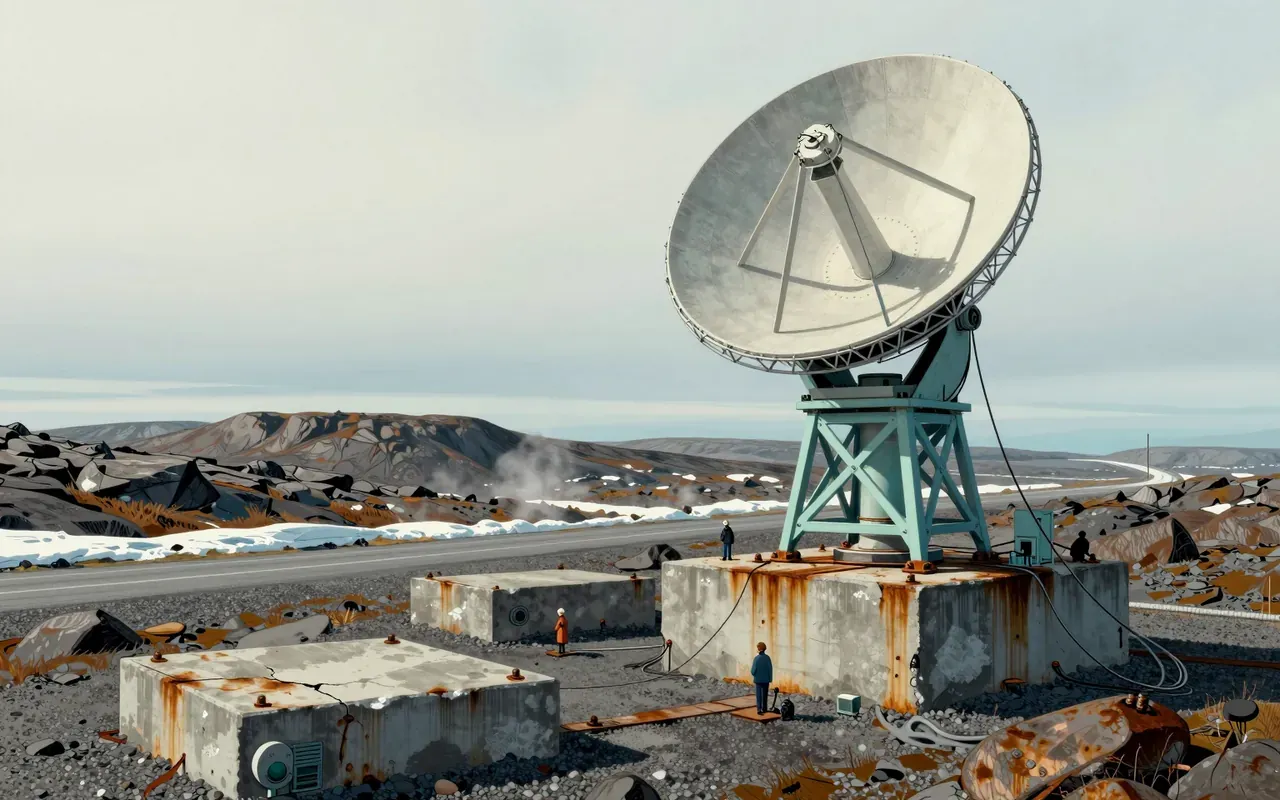
GLOBUSGLOBUS is a Norwegian radar installation in Vardø, operated by the Norwegian Intelligence Service for space observation and Arctic airspace monitoring — but technically integrated into U.S. missile defence and space surveillance systems via U.S. funding, U.S. contractor involvement, U.S. military designation (AN/FPS-129), and inclusion in the U.S. Space Surveillance Network. Its location — 50 km from the Soviet border and within visible range of Russia’s Kola Peninsula naval bases — makes it a persistent flashpoint. Construction spanned three phases: Globus I (1988), Globus II (1995, relocated 1999), and Globus III (2016). No revenue, no commercial activity, no private ownership — only layered sovereignty, contested function, and verified integration.
9:40
Robert MaxwellRobert Maxwell built Pergamon Press by acquiring Butterworth-Springer in 1951 and rebranding it. He inflated its share price using transactions between his private family companies. In 1969, he lost control and was expelled from its board. A government inquiry concluded he could not be relied upon to steward a publicly quoted company. In 1984, he acquired Mirror Group Newspapers for £113 million. His death triggered immediate loan calls and the collapse of his empire. Posthumously, his fraudulent misappropriation of the Mirror Group pension fund was revealed.
10:53
Apollo Global ManagementLeon Black · 1990Apollo Global Management is a $1.03 trillion alternative asset manager built on distressed-to-control investing, co-founded in 1990 by ex-Drexel bankers. It earns fees from pension funds, endowments, and sovereign wealth funds deploying capital across credit, private equity, and real assets. Its model works at scale—but its credibility fractures where leadership conduct contradicts its governance claims. The $158 million paid to Jeffrey Epstein did not disrupt operations, but it ended Leon Black’s tenure and exposed a rift between Apollo’s discipline-as-brand and its human risk.
Up next in Business

Telenor

1995 · 10:46

A state telegraph monopoly didn’t become a telecom giant by disrupting — it became one by outlasting.

10:46